924
Lectures Watched
Since January 1, 2014
Since January 1, 2014
- A History of the World since 1300 (68)
- History of Rock, 1970-Present (50)
- A Brief History of Humankind (48)
- Chinese Thought: Ancient Wisdom Meets Modern Science (35)
- The Modern World: Global History since 1760 (35)
- The Bible's Prehistory, Purpose, and Political Future (28)
- Introduction aux éthiques philosophiques (27)
- Jesus in Scripture and Tradition (25)
- Roman Architecture (25)
- Sexing the Canvas: Art and Gender (23)
- Descubriendo la pintura europea de 1400 a 1800 (22)
- Introduction aux droits de l'homme (19)
- Buddhism and Modern Psychology (18)
- Calvin: Histoire et réception d'une Réforme (17)
- The Ancient Greeks (16)
- À la découverte du théâtre classique français (15)
- The French Revolution (15)
- Letters of the Apostle Paul (14)
- Key Constitutional Concepts and Supreme Court Cases (14)
- Christianisme et philosophie dans l'Antiquité (14)
- Egiptología (12)
- Western Music History through Performance (10)
- The Rise of Superheroes and Their Impact On Pop Culture (9)
- The Great War and Modern Philosophy (9)
- Alexander the Great (9)
- Greek and Roman Mythology (9)
- Human Evolution: Past and Future (9)
- Phenomenology and the Conscious Mind (9)
- Masterpieces of World Literature (8)
- Villes africaines: la planification urbaine (8)
- Greeks at War: Homer at Troy (7)
- Pensamiento Científico (7)
- MongoDB for Node.js Developers (7)
- Fundamentos de la escritura en español (7)
- Introduction to Psychology (7)
- Programming Mobile Applications for Android (7)
- The Rooseveltian Century (6)
- Karl der Große - Pater Europae (6)
- Fake News, Facts, and Alternative Facts (6)
- Reason and Persuasion Through Plato's Dialogues (6)
- The Emergence of the Modern Middle East (6)
- A Beginner's Guide to Irrational Behavior (6)
- Lingua e cultura italiana: avanzata (6)
- L'avenir de la décision : connaître et agir en complexité (5)
- Understanding Einstein: The Special Theory of Relativity (5)
- Dinosaur Paleobiology (5)
- Exploring Beethoven's Piano Sonatas (5)
- War for the Greater Middle East (4)
- Emergence of Life (4)
- Introduction to Public Speaking (4)
- The Kennedy Half Century (4)
- Problèmes métaphysiques à l'épreuve de la politique, 1943-1968 (4)
- Designing Cities (4)
- Western Civilization: Ancient and Medieval Europe (3)
- Paleontology: Early Vertebrate Evolution (3)
- Orientierung Geschichte (3)
- Moons of Our Solar System (3)
- Introduction à la philosophie de Friedrich Nietzsche (3)
- Devenir entrepreneur du changement (3)
- La Commedia di Dante (3)
- History of Rock and Roll, Part One (3)
- Formation of the Universe, Solar System, Earth and Life (3)
- Initiation à la programmation en Java (3)
- La visione del mondo della Relatività e della Meccanica Quantistica (3)
- The Music of the Beatles (3)
- Analyzing the Universe (3)
- Découvrir l'anthropologie (3)
- Postwar Abstract Painting (3)
- The Science of Religion (2)
- La Philanthropie : Comprendre et Agir (2)
- Highlights of Modern Astronomy (2)
- Materials Science: 10 Things Every Engineer Should Know (2)
- The Changing Landscape of Ancient Rome (2)
- Lingua e letteratura in italiano (2)
- Gestion des aires protégées en Afrique (2)
- Géopolitique de l'Europe (2)
- Introduction à la programmation en C++ (2)
- Découvrir la science politique (2)
- Our Earth: Its Climate, History, and Processes (2)
- The European Discovery of China (2)
- Understanding Russians: Contexts of Intercultural Communication (2)
- Philosophy and the Sciences (2)
- Søren Kierkegaard: Subjectivity, Irony and the Crisis of Modernity (2)
- The Fall and Rise of Jerusalem (2)
- The Science of Gastronomy (2)
- Galaxies and Cosmology (2)
- Introduction to Classical Music (2)
- Art History for Artists, Animators and Gamers (2)
- L'art des structures 1 : Câbles et arcs (2)
- Russian History: from Lenin to Putin (2)
- The World of Wine (1)
- Wine Tasting: Sensory Techniques for Wine Analysis (1)
- William Wordsworth: Poetry, People and Place (1)
- The Talmud: A Methodological Introduction (1)
- Switzerland in Europe (1)
- The World of the String Quartet (1)
- Igor Stravinsky’s The Rite of Spring (1)
- El Mediterráneo del Renacimiento a la Ilustración (1)
- Science of Exercise (1)
- Социокультурные аспекты социальной робототехники (1)
- Russian History: from Lenin to Putin (1)
- The Rise of China (1)
- The Renaissance and Baroque City (1)
- Visualizing Postwar Tokyo (1)
- In the Night Sky: Orion (1)
- Oriental Beliefs: Between Reason and Traditions (1)
- The Biology of Music (1)
- Mountains 101 (1)
- Moral Foundations of Politics (1)
- Mobilité et urbanisme (1)
- Introduction to Mathematical Thinking (1)
- Making Sense of News (1)
- Magic in the Middle Ages (1)
- Introduction to Italian Opera (1)
- Intellectual Humility (1)
- The Computing Technology Inside Your Smartphone (1)
- Human Origins (1)
- Miracles of Human Language (1)
- From Goddard to Apollo: The History of Rockets (1)
- Hans Christian Andersen’s Fairy Tales (1)
- Handel’s Messiah and Baroque Oratorio (1)
- Theater and Globalization (1)
- Gestion et Politique de l'eau (1)
- Une introduction à la géographicité (1)
- Frontières en tous genres (1)
- Créer et développer une startup technologique (1)
- Découvrir le marketing (1)
- Escribir para Convencer (1)
- Anthropology of Current World Issues (1)
- Poetry in America: Whitman (1)
- Introducción a la genética y la evolución (1)
- Shakespeare: On the Page and in Performance (1)
- The Civil War and Reconstruction (1)
- Dinosaur Ecosystems (1)
- Développement durable (1)
- Vital Signs: Understanding What the Body Is Telling Us (1)
- Imagining Other Earths (1)
- Learning How to Learn (1)
- Miracles of Human Language: An Introduction to Linguistics (1)
- Web Intelligence and Big Data (1)
- Andy Warhol (1)
- Understanding the Brain: The Neurobiology of Everyday Life (1)
- Practicing Tolerance in a Religious Society (1)
- Subsistence Marketplaces (1)
- Physique générale - mécanique (1)
- Exercise Physiology: Understanding the Athlete Within (1)
- Introduction to Mathematical Philosophy (1)
- What Managers Can Learn from Great Philosophers (1)
- A la recherche du Grand Paris (1)
- The New Nordic Diet (1)
- A New History for a New China, 1700-2000 (1)
- The Magna Carta and its Legacy (1)
- The Age of Jefferson (1)
- History and Future of Higher Education (1)
- Éléments de Géomatique (1)
- 21st Century American Foreign Policy (1)
- The Law of the European Union (1)
- Design: Creation of Artifacts in Society (1)
- Introduction to Data Science (1)
- Configuring the World (1)
- From the Big Bang to Dark Energy (1)
- Animal Behaviour (1)
- Programming Mobile Services for Android Handheld Systems (1)
- The American South: Its Stories, Music, and Art (1)
- Care of Elders with Alzheimer's Disease (1)
- Contagious: How Things Catch On (1)
- Constitutional Law - The Structure of Government (1)
- Narratives of Nonviolence in the American Civil Rights Movement (1)
- Christianity: From Persecuted Faith to Global Religion (200-1650) (1)
- Age of Cathedrals (1)
- Controversies of British Imperialism (1)
- Big History: From the Big Bang until Today (1)
- Bemerkenswerte Menschen (1)
- The Art of Poetry (1)
- Superpowers of the Ancient World: the Near East (1)
- America Through Foreign Eyes (1)
- Advertising and Society (1)
Hundreds of free, self-paced university courses available:
my recommendations here
my recommendations here
Peruse my collection of 275
influential people of the past.
influential people of the past.
View My Class Notes via:


Receive My Class Notes via E-Mail:
Contact Me via E-Mail:
edward [at] tanguay.info
Notes on video lecture:
The Origins of Agriculture
Notes taken by Edward Tanguay on September 22, 2013 (go to class or lectures)

Choose from these words to fill the blanks below:
relaxed, Göbekli, pillars, miscalculation, generations, increased, gruel, 9000, spiritual, 2500, sedentary, choices, improve, temples, wheat, single, luxuries
•
the agricultural revolution occurred very gradually
•
a collection of attempts to life resulted in a more difficult life for most humans
•
why did humans make these to make their lives more difficult
•
it was a , as in other times in history
•
they were unable to foresee the full consequences of their choices
•
every time they decided to do extra work, e.g. to carry water from the river into the wheat fields, they reasoned that doing this would bring about a better life, e.g. the harvest will be more plentiful
•
the basic rule: if you work harder, you will have a better life for you and your children
•
they did work harder but in general, life was not easier or safer for humans
•
the number of children (hunter-gatherer women tended to have a child once the previous child was able to walk, i.e. every three years)
•
they had more food, but they will have more people to feed
•
feeding children with more porridge and instead of mother's milk would make them weaker and more sickly
•
increasing their dependence on a source of food like wheat, they increase the risk when calamities strike such a droughts
•
stockpiling food such as wheat grain tempted enemies to invade
•
even in good years, they will have to build walls, guard cities, and fight wars
•
why did humans not abandon this plan?
•
because it took to realize this, and by then, nobody ever really remembered how they use to live as hunters and gathers, most stories passed down were of the nature, "we use to have far less food"
•
there were too many people to go back to a hunter-gatherer life, people would starve if they went back to hunting and gathering
•
in this way, humans became trapped in a worse way of life
•
like a college student who wants to be a musician but decided to study computers in order to make money and retire at 30, there are unforeseen factors that arise
•
even if it works, you then have obligations and habits which prevent you from going back to your dream
•
this is what happened to our peasants ancestors
•
history has few laws which are always true, but one of the laws which is mostly true is that tend to become necessities
•
once people get used to a certain habit or luxury, they begin to count on it and take it for granted, and eventually they reach the position where they can't live without it
•
today we create devices to make our lives more , mostly we think they make our life easy
•
e.g. before e-mails it was difficult, expensive and slow to write to someone, now with e-mails we can do this within minutes
•
but do we live a more relaxed life because of the invention of e-mails? in many cases, the answer it ironically no
•
yes, e-mails make writing easier but the life of writing emails is not easier and more relaxed
•
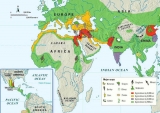
there are some people who don't use e-mail, and if you went back 10,000 years ago, you would find that not all bands had given up their forager life, but the agricultural revolution required only one group of humans for it to eventually spread to the rest
•
since farming creating the conditions for growth of populations ( mothers who could have a baby each year)
•
also when it came to conflict, peasants and farmers would almost always win over foragers since their sheer number
•
so once the move to agriculture started, the life of hunters and foragers was reduced incident by incident, year by year
•
the move to agriculture was a luxury trap that carried with it important lessons for humanity: that the search and constant progression towards an easier life releases forces of change that transform the world in ways that nobody could foresee and in ways that we ultimately may not find desirable.
•
History is full of series of decisions that fulfill short-term needs and desires but ultimately lead to large, unforeseen and undesirable results.
•
alternative explanation to the agricultural revolution
•
what brought about the agricultural revolution was not a search for a new life, but a aspiration
•
perhaps they were aware of the sacrifices of becoming peasants and farmers
•
archeologists have discovered an interesting site which gives credit to this theory
•
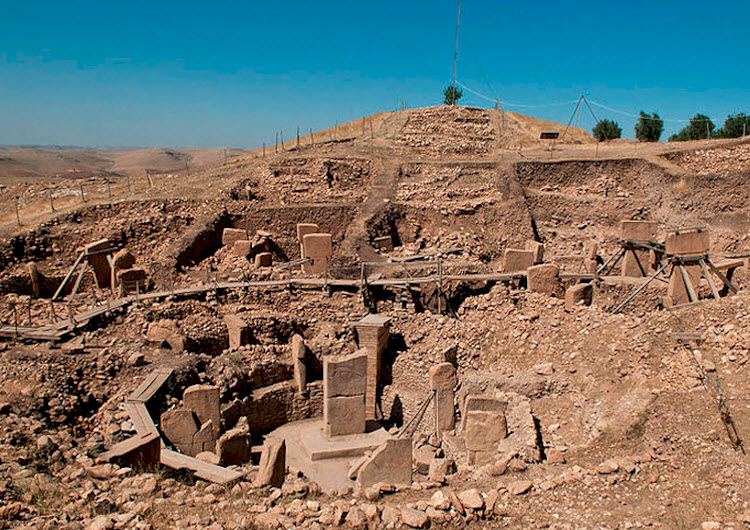
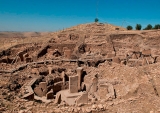
Tepe
•
in lowest stratum, they didn't discover houses but monumental structures with huge decorated with engravings
•
stone pillars covered with animals and creatures
•
similar to Stone Henge
•
dates to about B.C. and was built by a developed agricultural society
•
Göbekli Tepe, on the other hand, is dated to B.C. and evidence suggests that those who created it were not farmers but hunter/gatherers
•
it suggests that the skills of hunter/gathers was more developed than suspected
•
why would a hunter/gathers build such structures
•
cultural or religious purpose
•
they believed in these cultural or religious system enough to dedicate hundreds of thousands of manhours to build these structures
•
another discovery at Göbekli Tepe
•
it is very likely that the cultural center at Göbekli Tepe was connected to the cultivation of , i.e. in order to feed the large number of people who built Göbekli Tepe, it was necessary to find a food source that would feed them all, and hence the cultivation of wheat
•
we usually think that villages come before , that pioneers first build a village, and when the village is properous enough they set up a temple
•
but archeological site of Göbekli Tepe suggests that the temple was built first and villages only later grew around it
•
and that the initial reason for agriculture was for a cultural or religious purpose, and not for an economic purpose
•
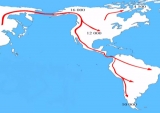
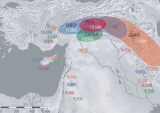
even if a strong connection between cultural/religious motives and the agricultural revolution is found, it doesn't explain the move to agriculture in other parts of the world such as North and South America
•
but it will prove that cultural and religion could have played a part in the agricultural revolution
 |  |  |
 |  |  |
 |  |  |
 |  |  |
 |  |  |
 |  |  |
 |  |  |
 |  |  |
 |  |  |
 |  |  |
 |  |  |
 |  |  |
 |  |  |
 |  |  |
 |  |  |
 |  |  |