924
Lectures Watched
Since January 1, 2014
Since January 1, 2014
- A History of the World since 1300 (68)
- History of Rock, 1970-Present (50)
- A Brief History of Humankind (48)
- Chinese Thought: Ancient Wisdom Meets Modern Science (35)
- The Modern World: Global History since 1760 (35)
- The Bible's Prehistory, Purpose, and Political Future (28)
- Introduction aux éthiques philosophiques (27)
- Jesus in Scripture and Tradition (25)
- Roman Architecture (25)
- Sexing the Canvas: Art and Gender (23)
- Descubriendo la pintura europea de 1400 a 1800 (22)
- Introduction aux droits de l'homme (19)
- Buddhism and Modern Psychology (18)
- Calvin: Histoire et réception d'une Réforme (17)
- The Ancient Greeks (16)
- À la découverte du théâtre classique français (15)
- The French Revolution (15)
- Letters of the Apostle Paul (14)
- Key Constitutional Concepts and Supreme Court Cases (14)
- Christianisme et philosophie dans l'Antiquité (14)
- Egiptología (12)
- Western Music History through Performance (10)
- The Rise of Superheroes and Their Impact On Pop Culture (9)
- The Great War and Modern Philosophy (9)
- Alexander the Great (9)
- Greek and Roman Mythology (9)
- Human Evolution: Past and Future (9)
- Phenomenology and the Conscious Mind (9)
- Masterpieces of World Literature (8)
- Villes africaines: la planification urbaine (8)
- Greeks at War: Homer at Troy (7)
- Pensamiento Científico (7)
- MongoDB for Node.js Developers (7)
- Fundamentos de la escritura en español (7)
- Introduction to Psychology (7)
- Programming Mobile Applications for Android (7)
- The Rooseveltian Century (6)
- Karl der Große - Pater Europae (6)
- Fake News, Facts, and Alternative Facts (6)
- Reason and Persuasion Through Plato's Dialogues (6)
- The Emergence of the Modern Middle East (6)
- A Beginner's Guide to Irrational Behavior (6)
- Lingua e cultura italiana: avanzata (6)
- L'avenir de la décision : connaître et agir en complexité (5)
- Understanding Einstein: The Special Theory of Relativity (5)
- Dinosaur Paleobiology (5)
- Exploring Beethoven's Piano Sonatas (5)
- War for the Greater Middle East (4)
- Emergence of Life (4)
- Introduction to Public Speaking (4)
- The Kennedy Half Century (4)
- Problèmes métaphysiques à l'épreuve de la politique, 1943-1968 (4)
- Designing Cities (4)
- Western Civilization: Ancient and Medieval Europe (3)
- Paleontology: Early Vertebrate Evolution (3)
- Orientierung Geschichte (3)
- Moons of Our Solar System (3)
- Introduction à la philosophie de Friedrich Nietzsche (3)
- Devenir entrepreneur du changement (3)
- La Commedia di Dante (3)
- History of Rock and Roll, Part One (3)
- Formation of the Universe, Solar System, Earth and Life (3)
- Initiation à la programmation en Java (3)
- La visione del mondo della Relatività e della Meccanica Quantistica (3)
- The Music of the Beatles (3)
- Analyzing the Universe (3)
- Découvrir l'anthropologie (3)
- Postwar Abstract Painting (3)
- The Science of Religion (2)
- La Philanthropie : Comprendre et Agir (2)
- Highlights of Modern Astronomy (2)
- Materials Science: 10 Things Every Engineer Should Know (2)
- The Changing Landscape of Ancient Rome (2)
- Lingua e letteratura in italiano (2)
- Gestion des aires protégées en Afrique (2)
- Géopolitique de l'Europe (2)
- Introduction à la programmation en C++ (2)
- Découvrir la science politique (2)
- Our Earth: Its Climate, History, and Processes (2)
- The European Discovery of China (2)
- Understanding Russians: Contexts of Intercultural Communication (2)
- Philosophy and the Sciences (2)
- Søren Kierkegaard: Subjectivity, Irony and the Crisis of Modernity (2)
- The Fall and Rise of Jerusalem (2)
- The Science of Gastronomy (2)
- Galaxies and Cosmology (2)
- Introduction to Classical Music (2)
- Art History for Artists, Animators and Gamers (2)
- L'art des structures 1 : Câbles et arcs (2)
- Russian History: from Lenin to Putin (2)
- The World of Wine (1)
- Wine Tasting: Sensory Techniques for Wine Analysis (1)
- William Wordsworth: Poetry, People and Place (1)
- The Talmud: A Methodological Introduction (1)
- Switzerland in Europe (1)
- The World of the String Quartet (1)
- Igor Stravinsky’s The Rite of Spring (1)
- El Mediterráneo del Renacimiento a la Ilustración (1)
- Science of Exercise (1)
- Социокультурные аспекты социальной робототехники (1)
- Russian History: from Lenin to Putin (1)
- The Rise of China (1)
- The Renaissance and Baroque City (1)
- Visualizing Postwar Tokyo (1)
- In the Night Sky: Orion (1)
- Oriental Beliefs: Between Reason and Traditions (1)
- The Biology of Music (1)
- Mountains 101 (1)
- Moral Foundations of Politics (1)
- Mobilité et urbanisme (1)
- Introduction to Mathematical Thinking (1)
- Making Sense of News (1)
- Magic in the Middle Ages (1)
- Introduction to Italian Opera (1)
- Intellectual Humility (1)
- The Computing Technology Inside Your Smartphone (1)
- Human Origins (1)
- Miracles of Human Language (1)
- From Goddard to Apollo: The History of Rockets (1)
- Hans Christian Andersen’s Fairy Tales (1)
- Handel’s Messiah and Baroque Oratorio (1)
- Theater and Globalization (1)
- Gestion et Politique de l'eau (1)
- Une introduction à la géographicité (1)
- Frontières en tous genres (1)
- Créer et développer une startup technologique (1)
- Découvrir le marketing (1)
- Escribir para Convencer (1)
- Anthropology of Current World Issues (1)
- Poetry in America: Whitman (1)
- Introducción a la genética y la evolución (1)
- Shakespeare: On the Page and in Performance (1)
- The Civil War and Reconstruction (1)
- Dinosaur Ecosystems (1)
- Développement durable (1)
- Vital Signs: Understanding What the Body Is Telling Us (1)
- Imagining Other Earths (1)
- Learning How to Learn (1)
- Miracles of Human Language: An Introduction to Linguistics (1)
- Web Intelligence and Big Data (1)
- Andy Warhol (1)
- Understanding the Brain: The Neurobiology of Everyday Life (1)
- Practicing Tolerance in a Religious Society (1)
- Subsistence Marketplaces (1)
- Physique générale - mécanique (1)
- Exercise Physiology: Understanding the Athlete Within (1)
- Introduction to Mathematical Philosophy (1)
- What Managers Can Learn from Great Philosophers (1)
- A la recherche du Grand Paris (1)
- The New Nordic Diet (1)
- A New History for a New China, 1700-2000 (1)
- The Magna Carta and its Legacy (1)
- The Age of Jefferson (1)
- History and Future of Higher Education (1)
- Éléments de Géomatique (1)
- 21st Century American Foreign Policy (1)
- The Law of the European Union (1)
- Design: Creation of Artifacts in Society (1)
- Introduction to Data Science (1)
- Configuring the World (1)
- From the Big Bang to Dark Energy (1)
- Animal Behaviour (1)
- Programming Mobile Services for Android Handheld Systems (1)
- The American South: Its Stories, Music, and Art (1)
- Care of Elders with Alzheimer's Disease (1)
- Contagious: How Things Catch On (1)
- Constitutional Law - The Structure of Government (1)
- Narratives of Nonviolence in the American Civil Rights Movement (1)
- Christianity: From Persecuted Faith to Global Religion (200-1650) (1)
- Age of Cathedrals (1)
- Controversies of British Imperialism (1)
- Big History: From the Big Bang until Today (1)
- Bemerkenswerte Menschen (1)
- The Art of Poetry (1)
- Superpowers of the Ancient World: the Near East (1)
- America Through Foreign Eyes (1)
- Advertising and Society (1)
Hundreds of free, self-paced university courses available:
my recommendations here
my recommendations here
Peruse my collection of 275
influential people of the past.
influential people of the past.
View My Class Notes via:


Receive My Class Notes via E-Mail:
Contact Me via E-Mail:
edward [at] tanguay.info
Notes on video lecture:
Hilda Rix Nicholas in Morocco
Notes taken by Edward Tanguay on August 8, 2017 (go to class or lectures)
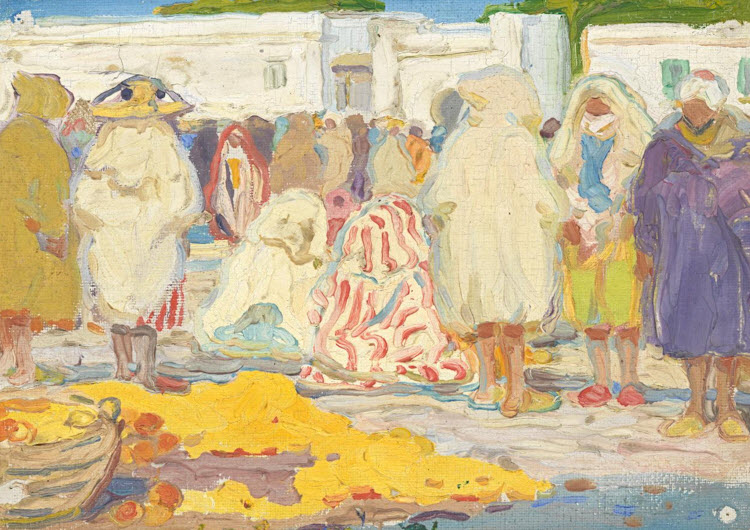

Choose from these words to fill the blanks below:
Lavery, Fromentin, 1961, closely, souk, Carrick, Matisse, Colarossi, Cezannesque, gender, Jewish, harems, France, model, counter, forbidden, flowers, plein, Zealand, Fauvism, rainy, impressionism, color, Delecluse, rights, creamy, towels, Algieria, women, Asa, Paris, Oranges, Australian, everyday, camels, Maghreb, haphazardly, soko, faces, Europe, Tangier, Mediterranean, male
•
Hilda Rix Nicholas (1884- )
•
artist
•
1912 visited John 's while visiting his studio in Morocco
•
one of the first Australian artists to visit Morocco
•
was in Morocco same time as Henri (1869-1954)
•
Matisse was the inventor of
•
began to experiment with post-
•
applied paint broadly upon the canvas
•
loose brush strokes
•
flattening out the picture plane
•
had studied in the National Gallery School in Melbourne
•
before going abroad with her mother and sister to study in London and
•
in Paris, studied at:
•
Académie
•
Académie
•
often attended Colarossi's studios to find a instead of hiring one for himself
•
held an open studio
•
Nicholas and Matisse might have met there
•
both painted views from their Hotel Villa de in Morocco
•
as well as views of the Bob El
•
the gate with marked the entry to Tangier
•
they shared models
•
Rix Nicholas' study in pastels of a young Moroccan youth entitled Hamido Sleeps
•
drawn from the same model as Matisse's Moroccan Hamido
•
Matisse rarely worked en air
•
preferred the studio
•
both of the artists complained of the weather, prevented them from getting out
•
Matisse painted throughout his life
•
one of the few mainstream male artists whose artistic practice continually returned to the floral motif
•
Rix Nicholas produced few floral studies
•
instead painted portraits and national life, which was considered a occupation
•
during two trips to
•
painted out in the (an open-air market in an Arabian city)
•
post-impressionist style
•
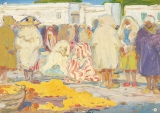
1912: "Marketplace with Pile of "
•
painted with flowing brush strokes in thick slabs of impasto
•
clearly delineates her figures
•
framed by buildings in the background
•
oranges arranged across the foreground
•
striped skirts and bright haiks of women
•
multicolored costumes of two man located on the right-hand side of the composition
•
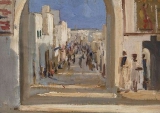
1914: "Through the Arch to the Sea"
•
painted a family
•
small alley way
•
white stone houses of the coast
•
challenges
•
the act of painting was frowned upon in Morocco and by some Muslims
•
she wrote in a letter home when sending a composition, "see how most of them are covering their , they have mostly cream draperies, and perhaps orange waistcoats, and little tight, mauve or green trousers, tied at the ankle."
•
difficult to paint oils in the market place
•
therefore executed most of her works in pencils and crayons
•
was fascinated by the marketplace
•
painting in public was tricky for a Western woman in Tangier
•
but not impossible as she demonstrated
•
Tangier
•
cosmopolitan community with a Christian and quarter
•
a long history of contact with
•
19th century, European artists traveled regularly there to paint
•
1830 France annexed
•
Eugene Delacroix was part of the official French delegation to Algiers
•
1833: Scottish painter David Roberts visited
•
1840s: Horace Vernet and Eugene
•
1870s: Louis Comfort Tiffany
•
"When I first had a change to travel in the east and to paint, I found that the buildings are clad in beautiful hues, the preeminence of in the world was brought forcibly to my attention."
•
by the middle of the 19th century, many European traveled to non-Western countries
•
Lady Isabel Burton (1831-1896)
•
writer and the wife and partner of explorer, adventurer, and writer Sir Richard Francis Burton (1821–1890)
•
Barbara Bodichon (1827-1891)
•
English educationalist and artist, and a leading mid-19th-century feminist and women's activist
•
both wrote accounts of their travels
•
by 20th century, female artists began to arrive in Tangier to paint
•
Francis Hodgkins (1869–1947)
•
from New
•
painter chiefly of landscape and still life
•
1905 produced paintings of marketplace in Tangier
•
Emanuel Phillips Fox (1865-1915) and wife Ethel (1872-1951)
•
Australian Impressionist painter
•
1905 traveled to North Africa to paint
•
Hilda Rix Nicholas recognized the view from their paintings from her hotel room
•
pictures gaze across the to Spain
•
the sea is rough and the waves have white caps
•
Hilda painted a similar composition
•
subtle pallet of white and pink tones and painted
•
the houses in the landscape are organized in blocks of color
•
focused on the everyday life of Moroccans
•
stressed the bonds and similarities which Europeans and Moroccans shared
•
her works made it clear that women played a prominent role in the life of the market
•
Berber women selling coal, brought to market on
•
independent women undertaking commercial roles in a public place
•
"Oh how you would love being with me today in the big soko. While a merry interested crowd gathered behind me, I put into my foreground one of the many women who had tramped 15 miles bearing a heavy load. She wore a scant attire made of a series of . Her face, all but the eyes, bound and veiled. Her legs were encased in primitive leather gaiters. The heels of her shoes were turned up. I got in my sketch before the teasing crowd had succeeded in informing her what was doing. Then I slipped away and got lost in the gaily colored multitude."
•
male artists were often interested in painting well worn themes of orientalism such as the adventures of the pashas and their
•
Hilda took what might described as a -orientalist view
•
sought to show that texture and color of the inhabitants, and their life, especially the women, with their families and their animals, uniting the Arab experience with human beings everywhere
•
as a women, she was able to observe more than a male artist might have been able to
•
was one of the first Australian artists to paint in a post-impressionist style
•
one of the first woman artists to attempt to translate the life of the into paint
•
after her expeditions to Morocco, she married an Australian sheep farmer
•
began recording the culture of the Australians
•
painting people of everyday life of pastoral Australia, especially women
•
1935: "The Fair Musterer"
•
encountered in Morocco radical aspects of post-impressionist practice
•
through contact with Henri Matisse
•
both went on to disregard oppressive stereotypes
•
painted in a way following their own ideas about gender
Ideas and Concepts:
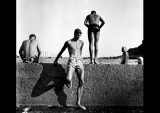
Inspiring thoughts and photography (Sunbaker, 1975) from Max Dupain (1911-1992), Australian modernist photographer, via this afternoon's Sexing the Canvas course: "Modern photography must do more than entertain, it must incite thought and by its clear statements of actuality, cultivate a sympathetic understanding of men and women and the life they live and create."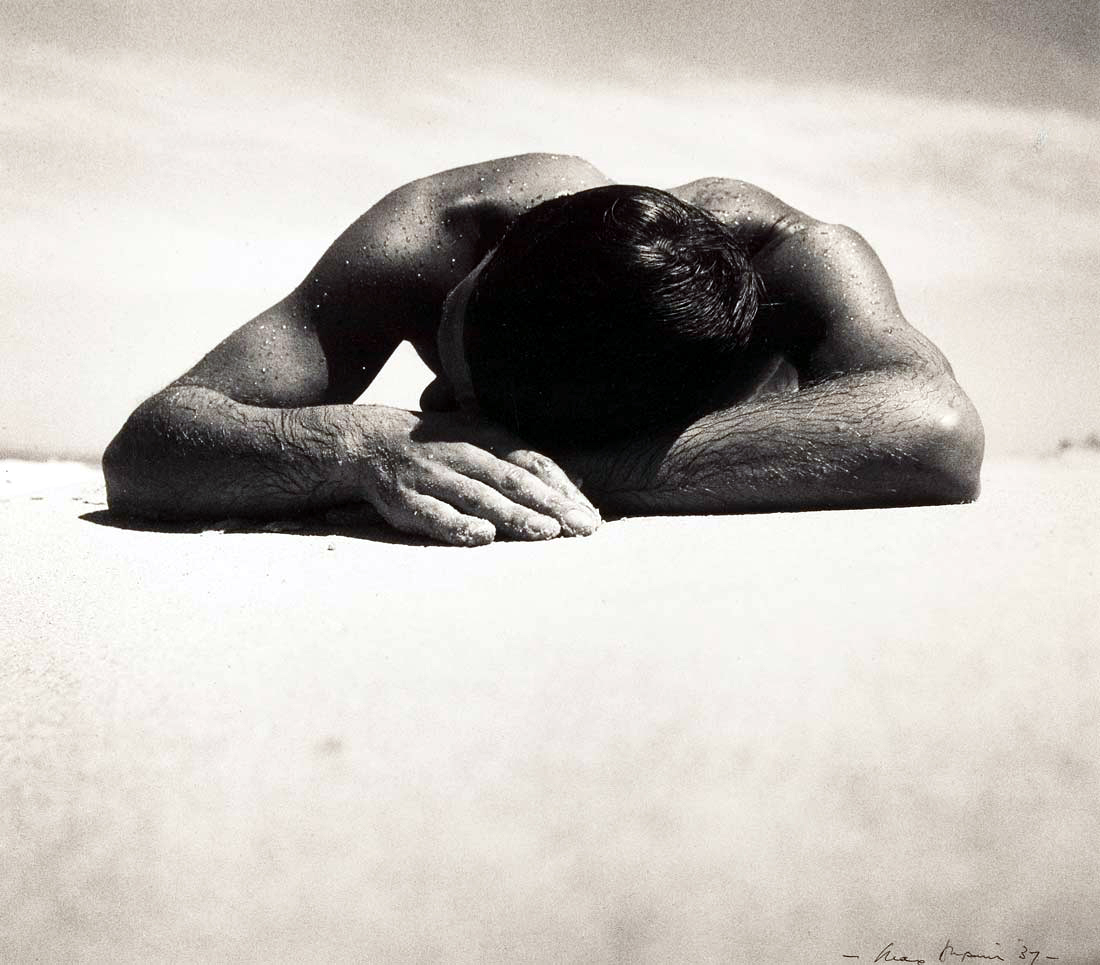
 |  |  |
 |  |  |
 |  |  |
 |  |  |
 |  |  |
 |  |  |
 |  |  |
 |  |