EDWARD'S LECTURE NOTES:
More notes at http://tanguay.info/learntracker
C O U R S E
Sexing the Canvas: Art and Gender
Jeanette Hoorn, The University of Melbourne
 |
C O U R S E L E C T U R E Hilda Rix Nicholas in Morocco Notes taken on August 8, 2017 by Edward Tanguay |
•
Hilda Rix Nicholas (1884-1961)
•
Australian artist
•
1912 visited John Lavery's while visiting his studio in Morocco
•
one of the first Australian artists to visit Morocco
•
was in Morocco same time as Henri Matisse (1869-1954)
•
Matisse was the inventor of Fauvism
•
began to experiment with post-impressionism
•
applied paint broadly upon the canvas
•
loose brush strokes
•
flattening out the picture plane
•
had studied in the National Gallery School in Melbourne
•
before going abroad with her mother and sister to study in London and Paris
•
in Paris, studied at:
•
Académie Delecluse
•
Académie Colarossi
•
often attended Colarossi's studios to find a model instead of hiring one for himself
•
held an open studio
•
Nicholas and Matisse might have met there
•
both painted views from their Hotel Villa de France in Morocco
•
as well as views of the Bob El Asa
•
the gate with marked the entry to Tangier
•
they shared models
•
Rix Nicholas' study in pastels of a young Moroccan youth entitled Hamido Sleeps
•
drawn from the same model as Matisse's Moroccan Hamido
•
Matisse rarely worked en plein air
•
preferred the studio
•
both of the artists complained of the rainy weather, prevented them from getting out
•
Matisse painted flowers throughout his life
•
one of the few mainstream male artists whose artistic practice continually returned to the floral motif
•
Rix Nicholas produced few floral studies
•
instead painted portraits and national life, which was considered a male occupation
•
during two trips to Tangier
•
painted out in the souk (an open-air market in an Arabian city)
•
post-impressionist style
•
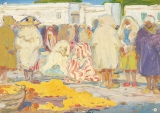
1912: "Marketplace with Pile of Oranges"
•
painted with flowing brush strokes in thick slabs of impasto
•
clearly delineates her figures
•
framed by buildings in the background
•
oranges arranged haphazardly across the foreground
•
striped skirts and bright haiks of women
•
multicolored costumes of two man located on the right-hand side of the composition
•
1914: "Through the Arch to the Sea"
•
painted a family
•
small alley way
•
white stone houses of the coast
•
challenges
•
the act of painting was frowned upon in Morocco and forbidden by some Muslims
•
she wrote in a letter home when sending a composition, "see how most of them are covering their faces, they have mostly cream draperies, and perhaps orange waistcoats, and little tight, mauve or green trousers, tied at the ankle."
•
difficult to paint oils in the market place
•
therefore executed most of her soko works in pencils and crayons
•
was fascinated by the marketplace
•
painting in public was tricky for a Western woman in Tangier
•
but not impossible as she demonstrated
•
Tangier
•
cosmopolitan community with a Christian and Jewish quarter
•
a long history of contact with Europe
•
19th century, European artists traveled regularly there to paint
•
1830 France annexed Algieria
•
Eugene Delacroix was part of the official French delegation to Algiers
•
1833: Scottish painter David Roberts visited
•
1840s: Horace Vernet and Eugene Fromentin
•
1870s: Louis Comfort Tiffany
•
"When I first had a change to travel in the east and to paint, I found that the buildings are clad in beautiful hues, the preeminence of color in the world was brought forcibly to my attention."
•
by the middle of the 19th century, many European women traveled to non-Western countries
•
Lady Isabel Burton (1831-1896)
•
writer and the wife and partner of explorer, adventurer, and writer Sir Richard Francis Burton (1821–1890)
•
Barbara Bodichon (1827-1891)
•
English educationalist and artist, and a leading mid-19th-century feminist and women's rights activist
•
both wrote accounts of their travels
•
by 20th century, female artists began to arrive in Tangier to paint
•
Francis Hodgkins (1869–1947)
•
from New Zealand
•
painter chiefly of landscape and still life
•
1905 produced paintings of marketplace in Tangier
•
Emanuel Phillips Fox (1865-1915) and wife Ethel Carrick (1872-1951)
•
Australian Impressionist painter
•
1905 traveled to North Africa to paint
•
Hilda Rix Nicholas recognized the view from their paintings from her hotel room
•
pictures gaze across the Mediterranean to Spain
•
the sea is rough and the waves have white caps
•
Hilda painted a similar composition
•
subtle pallet of creamy white and pink tones and painted
•
the houses in the landscape are organized in Cezannesque blocks of color
•
focused on the everyday life of Moroccans
•
stressed the bonds and similarities which Europeans and Moroccans shared
•
her works made it clear that women played a prominent role in the life of the market
•
Berber women selling coal, brought to market on camels
•
independent women undertaking commercial roles in a public place
•
"Oh how you would love being with me today in the big soko. While a merry interested crowd gathered behind me, I put into my foreground one of the many women who had tramped 15 miles bearing a heavy load. She wore a scant attire made of a series of towels. Her face, all but the eyes, bound and veiled. Her legs were encased in primitive leather gaiters. The heels of her shoes were turned up. I got in my sketch before the teasing crowd had succeeded in informing her what was doing. Then I slipped away and got lost in the gaily colored multitude."
•
male artists were often interested in painting well worn themes of orientalism such as the adventures of the pashas and their harems
•
Hilda took what might described as a counter-orientalist view
•
sought to show that texture and color of the inhabitants, and their everyday life, especially the women, with their families and their animals, uniting the Arab experience with human beings everywhere
•
as a women, she was able to observe more closely than a male artist might have been able to
•
was one of the first Australian artists to paint in a post-impressionist style
•
one of the first woman artists to attempt to translate the life of the Maghreb into paint
•
after her expeditions to Morocco, she married an Australian sheep farmer
•
began recording the culture of the Australians
•
painting people of everyday life of pastoral Australia, especially women
•
1935: "The Fair Musterer"
•
encountered in Morocco radical aspects of post-impressionist practice
•
through contact with Henri Matisse
•
both went on to disregard oppressive gender stereotypes
•
painted in a way following their own ideas about gender