924
Lectures Watched
Since January 1, 2014
Since January 1, 2014
- A History of the World since 1300 (68)
- History of Rock, 1970-Present (50)
- A Brief History of Humankind (48)
- Chinese Thought: Ancient Wisdom Meets Modern Science (35)
- The Modern World: Global History since 1760 (35)
- The Bible's Prehistory, Purpose, and Political Future (28)
- Introduction aux éthiques philosophiques (27)
- Jesus in Scripture and Tradition (25)
- Roman Architecture (25)
- Sexing the Canvas: Art and Gender (23)
- Descubriendo la pintura europea de 1400 a 1800 (22)
- Introduction aux droits de l'homme (19)
- Buddhism and Modern Psychology (18)
- Calvin: Histoire et réception d'une Réforme (17)
- The Ancient Greeks (16)
- À la découverte du théâtre classique français (15)
- The French Revolution (15)
- Letters of the Apostle Paul (14)
- Key Constitutional Concepts and Supreme Court Cases (14)
- Christianisme et philosophie dans l'Antiquité (14)
- Egiptología (12)
- Western Music History through Performance (10)
- The Rise of Superheroes and Their Impact On Pop Culture (9)
- The Great War and Modern Philosophy (9)
- Alexander the Great (9)
- Greek and Roman Mythology (9)
- Human Evolution: Past and Future (9)
- Phenomenology and the Conscious Mind (9)
- Masterpieces of World Literature (8)
- Villes africaines: la planification urbaine (8)
- Greeks at War: Homer at Troy (7)
- Pensamiento Científico (7)
- MongoDB for Node.js Developers (7)
- Fundamentos de la escritura en español (7)
- Introduction to Psychology (7)
- Programming Mobile Applications for Android (7)
- The Rooseveltian Century (6)
- Karl der Große - Pater Europae (6)
- Fake News, Facts, and Alternative Facts (6)
- Reason and Persuasion Through Plato's Dialogues (6)
- The Emergence of the Modern Middle East (6)
- A Beginner's Guide to Irrational Behavior (6)
- Lingua e cultura italiana: avanzata (6)
- L'avenir de la décision : connaître et agir en complexité (5)
- Understanding Einstein: The Special Theory of Relativity (5)
- Dinosaur Paleobiology (5)
- Exploring Beethoven's Piano Sonatas (5)
- War for the Greater Middle East (4)
- Emergence of Life (4)
- Introduction to Public Speaking (4)
- The Kennedy Half Century (4)
- Problèmes métaphysiques à l'épreuve de la politique, 1943-1968 (4)
- Designing Cities (4)
- Western Civilization: Ancient and Medieval Europe (3)
- Paleontology: Early Vertebrate Evolution (3)
- Orientierung Geschichte (3)
- Moons of Our Solar System (3)
- Introduction à la philosophie de Friedrich Nietzsche (3)
- Devenir entrepreneur du changement (3)
- La Commedia di Dante (3)
- History of Rock and Roll, Part One (3)
- Formation of the Universe, Solar System, Earth and Life (3)
- Initiation à la programmation en Java (3)
- La visione del mondo della Relatività e della Meccanica Quantistica (3)
- The Music of the Beatles (3)
- Analyzing the Universe (3)
- Découvrir l'anthropologie (3)
- Postwar Abstract Painting (3)
- The Science of Religion (2)
- La Philanthropie : Comprendre et Agir (2)
- Highlights of Modern Astronomy (2)
- Materials Science: 10 Things Every Engineer Should Know (2)
- The Changing Landscape of Ancient Rome (2)
- Lingua e letteratura in italiano (2)
- Gestion des aires protégées en Afrique (2)
- Géopolitique de l'Europe (2)
- Introduction à la programmation en C++ (2)
- Découvrir la science politique (2)
- Our Earth: Its Climate, History, and Processes (2)
- The European Discovery of China (2)
- Understanding Russians: Contexts of Intercultural Communication (2)
- Philosophy and the Sciences (2)
- Søren Kierkegaard: Subjectivity, Irony and the Crisis of Modernity (2)
- The Fall and Rise of Jerusalem (2)
- The Science of Gastronomy (2)
- Galaxies and Cosmology (2)
- Introduction to Classical Music (2)
- Art History for Artists, Animators and Gamers (2)
- L'art des structures 1 : Câbles et arcs (2)
- Russian History: from Lenin to Putin (2)
- The World of Wine (1)
- Wine Tasting: Sensory Techniques for Wine Analysis (1)
- William Wordsworth: Poetry, People and Place (1)
- The Talmud: A Methodological Introduction (1)
- Switzerland in Europe (1)
- The World of the String Quartet (1)
- Igor Stravinsky’s The Rite of Spring (1)
- El Mediterráneo del Renacimiento a la Ilustración (1)
- Science of Exercise (1)
- Социокультурные аспекты социальной робототехники (1)
- Russian History: from Lenin to Putin (1)
- The Rise of China (1)
- The Renaissance and Baroque City (1)
- Visualizing Postwar Tokyo (1)
- In the Night Sky: Orion (1)
- Oriental Beliefs: Between Reason and Traditions (1)
- The Biology of Music (1)
- Mountains 101 (1)
- Moral Foundations of Politics (1)
- Mobilité et urbanisme (1)
- Introduction to Mathematical Thinking (1)
- Making Sense of News (1)
- Magic in the Middle Ages (1)
- Introduction to Italian Opera (1)
- Intellectual Humility (1)
- The Computing Technology Inside Your Smartphone (1)
- Human Origins (1)
- Miracles of Human Language (1)
- From Goddard to Apollo: The History of Rockets (1)
- Hans Christian Andersen’s Fairy Tales (1)
- Handel’s Messiah and Baroque Oratorio (1)
- Theater and Globalization (1)
- Gestion et Politique de l'eau (1)
- Une introduction à la géographicité (1)
- Frontières en tous genres (1)
- Créer et développer une startup technologique (1)
- Découvrir le marketing (1)
- Escribir para Convencer (1)
- Anthropology of Current World Issues (1)
- Poetry in America: Whitman (1)
- Introducción a la genética y la evolución (1)
- Shakespeare: On the Page and in Performance (1)
- The Civil War and Reconstruction (1)
- Dinosaur Ecosystems (1)
- Développement durable (1)
- Vital Signs: Understanding What the Body Is Telling Us (1)
- Imagining Other Earths (1)
- Learning How to Learn (1)
- Miracles of Human Language: An Introduction to Linguistics (1)
- Web Intelligence and Big Data (1)
- Andy Warhol (1)
- Understanding the Brain: The Neurobiology of Everyday Life (1)
- Practicing Tolerance in a Religious Society (1)
- Subsistence Marketplaces (1)
- Physique générale - mécanique (1)
- Exercise Physiology: Understanding the Athlete Within (1)
- Introduction to Mathematical Philosophy (1)
- What Managers Can Learn from Great Philosophers (1)
- A la recherche du Grand Paris (1)
- The New Nordic Diet (1)
- A New History for a New China, 1700-2000 (1)
- The Magna Carta and its Legacy (1)
- The Age of Jefferson (1)
- History and Future of Higher Education (1)
- Éléments de Géomatique (1)
- 21st Century American Foreign Policy (1)
- The Law of the European Union (1)
- Design: Creation of Artifacts in Society (1)
- Introduction to Data Science (1)
- Configuring the World (1)
- From the Big Bang to Dark Energy (1)
- Animal Behaviour (1)
- Programming Mobile Services for Android Handheld Systems (1)
- The American South: Its Stories, Music, and Art (1)
- Care of Elders with Alzheimer's Disease (1)
- Contagious: How Things Catch On (1)
- Constitutional Law - The Structure of Government (1)
- Narratives of Nonviolence in the American Civil Rights Movement (1)
- Christianity: From Persecuted Faith to Global Religion (200-1650) (1)
- Age of Cathedrals (1)
- Controversies of British Imperialism (1)
- Big History: From the Big Bang until Today (1)
- Bemerkenswerte Menschen (1)
- The Art of Poetry (1)
- Superpowers of the Ancient World: the Near East (1)
- America Through Foreign Eyes (1)
- Advertising and Society (1)
Hundreds of free, self-paced university courses available:
my recommendations here
my recommendations here
Peruse my collection of 275
influential people of the past.
influential people of the past.
View My Class Notes via:


Receive My Class Notes via E-Mail:
Contact Me via E-Mail:
edward [at] tanguay.info
Notes on video lecture:
Why People Cheat and Its Economic Impact
Notes taken by Edward Tanguay on October 13, 2015 (go to class or lectures)

Choose from these words to fill the blanks below:
rationalize, dishonest, whatsoever, Becker, signature, identify, cashless, encourage, thinking, exaggerate, honor, college, home, afterward, consequences, partially, tokens, everything, top, reminder, honest, creative, confusing, steal, dishonest, personality, benefit, down, front, concept, accounting, remembered, dollar, atheists, distanced, billion, cheating, deserved, invented, measurable, social, tempted, economic, agreement, verification, despite
•
fudge factor
•
due to our flexible cognitive ability, the fact that we can things very quickly, as long as we cheat just a little bit, we can both benefit from cheating, and we can still see ourselves as honorable people
•
the moment we start creating a behavior, there is a range before it invokes a different concept of ourselves, and in that range, we can both be dishonest and think of ourselves as honest people
•
people try to balance two forces
•
1. feel that we are good, moral, people
•
2. benefit from
•
the moment we start creating a dishonest behavior, there is a range before it invokes a different of ourselves
•
in that range, one can both be and think of oneself as an honest person
•
experiment: How much will people cheat after trying to recall the Ten Commandments?
•
answer: very little
•
UCLA, asked 500 students
•
interestingly, none of them could recall all 10 commandments and some of them new ones
•
but after getting them to try to remember the ten commandments, they were given the same math task as before
•
there was no correlation between people who more commandments to those who cheat less
•
even those who were self-declared did not cheat after thinking about the ten commandments
•
conclusion: just about morality shrinks our willingness to cheat and can make us more honest
•
experiment: secular version of the above: how much will people cheat after being reminded of the code?
•
at MIT and Yale
•
has no Honor Code
•
added one sentence to beginning of test:
•
"I understand that this test falls under the MIT/Yale Honor Code."
•
required a
•
result: no cheating
•
the fact the neither MIT nor Yale actually have an Honor Code
•
there were actually no costs associated with cheating
•
just the of some moral element of cheating decreased it so far that none could be detected
•
at Princeton
•
has Honor Code
•
they give Freshmen a week long lesson on honesty
•
crash course on morality
•
two weeks after, we students in same way
•
when they did not sign the code, they cheated similarly to the Yale/MIT students
•
when they did sign the code, they didn't cheat
•
bad news
•
a week-long course in morality doesn't seem to have any effects two weeks down the road
•
morality training doesn't seem to be that effective
•
good news
•
reminding people about their own morality, whether it has or not
•
take away
•
rather than thinking about global, cultural changes, we should think about how we change things just before people are tempted in being dishonest
•
ideas to improve IRS form
•
some people signed an honor code before a test and after a test
•
those who signed it before the test cheated less than those who signed it
•
went to IRS and said that they should put the signature at the front
•
the IRS responded that it would be illegal to do this since the signature on your IRS form is meant for , not for priming morality
•
so they suggested to the IRS that they put a signature in the and in the back each with a different purpose
•
the IRS responded that this would be
•
we then suggested that the first question ask if the person wants to donate $25 to a task force to fight corruption, as this would also prime people to think about ethics before doing their taxes
•
insurance company
•
said that the cheating they see was similar to these experiments
•
that few people invent crimes that happened to them, but many people their claims, probably around 10-15%
•
costs the industry around $24 per year
•
ideas
•
while people are on hold, play religious music for them
•
put images of eyes, as if they are being watched, on the forms
•
got them to sign first
•
one forms that asked how much people drove each year, they moved the signature line to the
•
results indicated that cheating was reduced
•
how do you get people to cheat more and still feel comfortable with themselves
•
for the purpose of understanding it
•
people will pencils from work which cost 50 cents, but they won't steal 50 cents from work
•
the further what we steal is from money, the more stories we can tell ourselves to rationalize our actions so that we can cheat more but nevertheless feel better about ourselves
•
the workplace wants us to have these pencils, otherwise they wouldn't put them there
•
other people take them as well
•
I use them for work anyway
•
coke experiment
•
put six-packs of coke in refrigerators where people had common food
•
wanted to see what the half-life of coke was
•
on the average, within 72 hours, no cokes were left
•
I put six one bills on a plate in the refrigerator and nobody took them
•
same experiment with tokens
•
lying for tokens was done more often than lying for money
•
but then they replaced these for money
•
this is one of the most worrisome experiments that I have ever done
•
since we are moving to be a society
•
digital wallets
•
online shopping
•
financial investment software
•
stock options
•
how to increase cheating
•
increase distance from money
•
if being close to money, being able to hold it and see it is keeping us honest, the more our distance to coins and bills increases, the more we can be dishonest and think of ourselves as honest
•
provide examples of others cheating
•
1. experiment, actor who cheats
•
at the beginning, they got an envelope with all the money and they had to pay
•
take only the money they
•
hired an acting student, after 30 seconds, "I solved , what do I do now"
•
others know that he had to have cheated
•
teacher said, you are free to go, he took whole envelope
•
results were: many more people cheated
•
1. it's a cost/ analysis: at the beginning you don't know what the cost of cheating is
•
2. social proof: a social perspective
•
2. actor who asks about cheating
•
switched it again: actor said, "can't I just say I solve everything and go ", instrutor said, "yes you can, it's up to you"
•
cheating actually when
•
3. actor with different outfit
•
dressed acting student with clothes from another
•
others didn't with him
•
cheating went down
•
cheating based on type
•
people in general want to view themselves as honest people yet benefit from cheating
•
people
•
you need to cheat and rationalize, i.e. they can tell better stories
•
result: more creative people cheat more
•
advertising agency
•
less cheating in , and much more cheating in the creative professions
•
cheating is all about rationalizing
•
three things that make people cheat more:
•
1. increase the distance from money
•
2. social acceptance: seeing other people in your group cheat
•
3. creativity: the more creative and the better able to rationalize
•
theories
•
model: cost/benefit analysis
•
doesn't explain much of our behavior
•
bad apple
•
not so much due to one person cheating a lot but many people cheating a little bit
•
cheating comes from people finding the fine line between feeling good about themselves and getting the benefits of cheating
•
to less cheating
•
find ways to allow people to feel comfortable with less cheating
•
help people become aware of these traps
•
create rules that don't allow this flexibility in rationalization
•
results of experiments
•
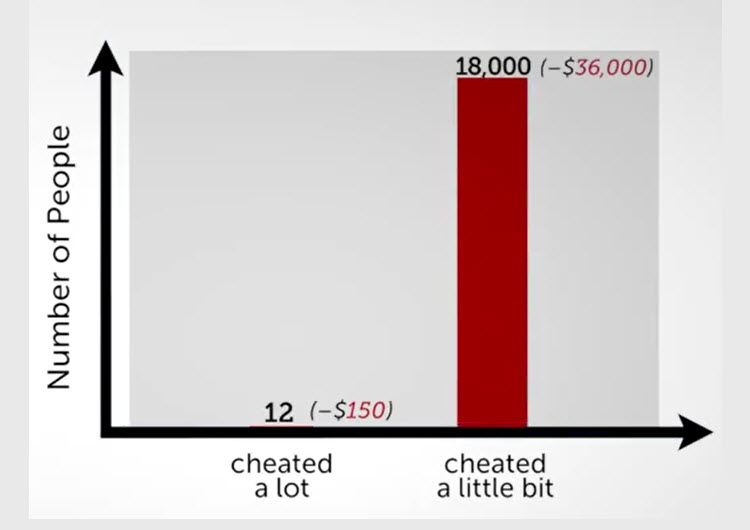
30,000 people tested
•
we found about 12 people who cheated a lot, lost about $150 on them
•
we found about 18,000 people who cheated a little bit and lost about $36,000 on them
•
we learned that the impact from cheating comes much more from a large amount of people cheating a little and not from a few people cheating a lot
Spelling Corrections:
refridgerators ⇒ refrigerators
Ideas and Concepts:
On honesty in a cashless society via this afternoon's Irrational Behavior class: "One of the most worrisome psychological experiments I have conducted was one where students were encouraged to cheat on a test in that they were able to report by themselves how many questions they got right, and would immediately receive either (1) direct cash for each question, or (2) tokens for each question which they could then exchange for cash. Students who received tokens consistently cheated more than those who received cash, which indicated that the further our actions are removed from physical money, the more we have room to rationalize dishonest behavior. This is worrisome in that our society is gradually moving to be a cashless society where digital wallets, stock options, financial investment software, online shopping and smart phone payments are becoming the prevalent way to do commerce. If being close to physical money, being able to see it and touch it, is one thing that is keeping us honest, then the greater our distance to coins and bills, the easier it will be for us to be dishonest while still thinking of ourselves as honest."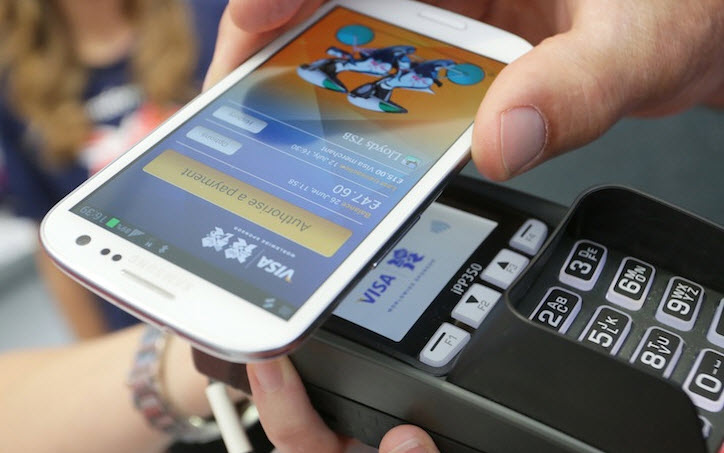
 |  |  |
 |  |  |