EDWARD'S LECTURE NOTES:
More notes at http://tanguay.info/learntracker
C O U R S E
The Modern World: Global History since 1760
Prof. Philip Zelikow, University of Virginia
 |
C O U R S E L E C T U R E 1945: Hour Zero Notes taken on April 27, 2014 by Edward Tanguay |
•
Zero Hour, or "Stunde Null"
•
"everything is destroyed and we are starting over from scratch"
•
total war
•
means if your military situation is unstable, you might not just lose the war, you might lose everything, e.g. be enslaved or murdered
•
nations in arms
•
mobilizing men, women and children
•
everyone in the war effort, everyone working in, for, or around the government
•
the war was affecting everyone
•
rationing
•
the year of 1944
•
the bloodiest year of fighting
•
fighting fanatically from strong, fortified positions of defense
•
battle lines
•
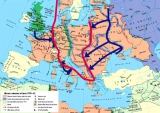
Europe 1944
•
Eastern front: took a year to move into Europe
•
Italian front: took a year to move up into Northern Italy
•
French front: took a year to move across the channel and to border of Germany
•
after Italy had gone out of war, took six months to liquidate the German empire
•
Pacific
•
Americans and Allies turned tide and started moving toward Japan
•
maintained supplies to the Chinese
•
fighting in Burma
•
the world of 1945
•
severe devastation
•
Germany carved up into Allied zones of occupation
•
Vienna was also divided into zones of occupation
•
Japan
•
quit the war before their country was invaded and fought over from one end to the other as Germany was
•
but American bombing raids destroyed over 50% of many cities
•
air raid on Tokyo in March 1945 killed about 100,000 people
•
atomic bombs on Hiroshima and Nagasaki
•
in the case of fire raids and the atomic bombs, the Allies were desperate to use any means they had to stop the war and saw cities as military targets
•
both sides were becoming debased in their attitude toward human life
•
the Allies knew they were doing horrifying things to win the war
•
bombing cities in order to end the war does not equate to constructing death factories to carry out the genocides of a whole people whom they hoped to enslave and then exterminate
•
it was clear that this war was pushing human civilization to the brink, where people are creating destructive powers that are beyond human reason and human spirituality, and then the war ended
•
the end of the war
•
Germany
•
no German government to take a surrender, the American regarded the German government "as nothing, as wreckage"
•
they took a surrender from German generals in the field in a simple little ceremony in a French school house
•
Japan
•
Allies allowed a Japanese government to remain
•
allowed Japanese emperor to remain in power
•
formal surrender ceremony on Battleship Missouri, September 1945
•
visions of modern society looking forward after the war
•
era of high modernism: government planning as its height
•
high liberalism
•
the war was thought of rescuing the world from tyranny and liberals had always thought of themselves as tyrants
•
the ideals that Americans had stood for in the war made it harder to maintain the regime of Jim Crow in the American South
•
discover society
•
society of an object that would be the focal point of engineering
•
society as something I manipulate through the choices of big thinking planners
•
economic management: the demands of having to manage large territories all over the world, and manage whole economies
•
urban management: mayors planning and managing large-scale cities
•
war management
•
access to raw materials
•
allocation of production facilities
•
use of man-power
•
modernism
•
by the end of the 1940s there was a sense that you "wanted to be modern"
•
a level of cultural conformity
•
"if you're not modern yet, we want to make you modern"
•
top-down organizers of cities and societies
•
lessons from the war
•
who were the models of success who showed people and countries the way of the future?
•
1. United States
•
James Burnham, "Managerial Revolution"
•
American, Princeton graduate
•
was an early communist in the 1930s but became disillusioned with the Stalinist communist party
•
late 30s became Trotskyite
•
eventually became an American right wing conservative, eventually earned accolades by Ronald Reagan
•
1940s book "Managerial Revolution"
•
Soviet Union, United States, is all becoming pretty much alike, its a matter of big organizations run by technocratic managers who are going to arrange everything in society
•
the rule of the administrators, on a gigantic scale
•
George Orwell, "1984"
•
he is reacting to Burnham
•
a world dominated by endlessly warring governments, very much alike, dominated by powerful bureaucrats
•
F.A. Hayek, "The Road to Serfdom", 1944
•
visions like those of James Burnham are extremely prescient, and that people need to fight it.
•
a European liberal, deeply liberal from the old school, almost a revival of Adam Smith or John Stuart Mill
•
asked the question: who will buy the goods?
•
concerns
•
no renewal of the war
•
also no renewal of the Great Depression
•
strategies
•
maintain wartime alliance
•
disable Germany and Japan
•
international cooperation, new institutions
•
World Bank
•
United Nations
•
building a functioning world economy
•
much more concerned about this than the Soviets
•
concerned with world trade collapsing as it did in 1929
•
how to end empires and trusteeships, part of the old world that needs to be swept away
•
open up the world for opportunities for American business
•
in the 1930s, the British put up a trade wall around the British Empire and so some of the post-war push for an open global economy was a conflict not only with the Soviets, but with the British, and partly with the French
•
2. Soviet Union
•
Stalin's meeting with the Allies
•
February 1945 meet in Yalta on Black Sea
•
July 1945 in Potsdam
•
Truman just became president in April
•
Stalin's concerns
•
the future of the Soviet Union was bound up with the future of communism and the world revolutionary agenda
•
the better communism did, the weaker capitalism became, the more secure the Soviet Union would be
•
strategies
•
territorial expansion
•
protective barrier
•
disable Germany and Japan
•
maintain wartime alliance as long as possible
•
maintain a global network of obedient communist parties
•
likely points of friction in 1945
•
annexations
•
Soviets taking chunks out of the expanded German Reich
•
moving the whole country of Poland about 150 miles to the west
•
British and France had gone to war in 1939 to fight for the security of Poland
•
Poland's important to Americans as well
•
joint duties in Germany
•
running up against each other, having to work together, even though your systems are different
•
in non-communist countries which have communist groups who are trying to overthrow the country
•
France and Italy, where these are domestic classes about the future of their country
•
issues of trade and exchange
•
decolonization