EDWARD'S LECTURE NOTES:
More notes at http://tanguay.info/learntracker
C O U R S E
Analyzing the Universe
Terry Matilsky, Rutgers University
 |
C O U R S E L E C T U R E Capturing Images of X-Ray Sources from Space Notes taken on January 12, 2015 by Edward Tanguay |
•
visible light can be bounced of a curved mirror and directed to a focal point
•
x-ray light, however, will be absorbed by the mirror
•
will not bounce back to the focal point
•
X-ray photons penetrate into the mirror in much the same way that bullets slam into a wall
•
likewise, just as bullets ricochet when they hit a wall at a grazing angle, so too will X-rays ricochet off mirrors
•
therefore X-ray telescopes must be constructed very different from optical telescopes
•
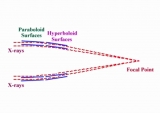
mirrors have to be precisely shaped and aligned nearly parallel to incoming X-rays
•
they look more like barrels than the familiar dish shape of optical telescopes
•
x-ray telescope
•
designed to observe remote objects in the X-ray spectrum
•
the Earth's atmosphere absorbs X-rays, X-ray observatories
•
must therefore be mounted on high altitude rockets or artificial satellites in order to get above the Earth's atmosphere
•
mirrors, detectors, and electronics that convey the information back to Earth must be able to
•
withstand the rigors of a rocket launch
•
operate in the hostile environment of space
•
NASA's Chandra X-ray Observatory
•
most important X-ray astronomy mission to date
•
launched on July 23, 1999
•
four sets of nested mirrors
•
the mirror surface was coated with iridium, a material more reflective than gold
•
Sco X-1 (Scorpius X-1)
•
roughly 9000 light years away in the constellation Scorpius
•
aside from the Sun, it is the strongest apparent source of X-rays in the sky
•
is associated with an optically visible star, V818 Scorpii