EDWARD'S LECTURE NOTES:
More notes at http://tanguay.info/learntracker
C O U R S E
The Modern World: Global History since 1760
Prof. Philip Zelikow, University of Virginia
 |
C O U R S E L E C T U R E 1958-1962: The World at the Brink Notes taken on August 2, 2014 by Edward Tanguay |
•
1958-1962: the years of maximum crisis during the Cold War
•
1957: Sputnik
•
the curtain raiser for this four-year period
•
USSR demonstrates its ability to launch heavy missiles and put things into space
•
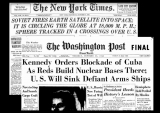
October 4, 1957: Sputnik
•
circled globe at 18,000 M.P.H.
•
was crossing the United States
•
1958 crises
•
1. Middle East crisis
•
Iraq
•
monarchy that had long been supported by British and Americans was overthrown
•
Kingdom of Iraq's Hashemite monarchy was overthrown, ruler murdered
•
Hashemite monarchy had been established by King Faisal I in 1921 under the auspices of the British
•
ruler murdered
•
nationalist dictatorship takes its place
•
America
•
worried that Soviets would meddle
•
tried to stay on the right side of Arab nationalism
•
tried to create an Arab bulwark against Soviet penetration there
•
2. Taiwan Straits crisis
•
USA defends the Republic of China (Taiwan) because of a treaty
•
finds itself in a long-grade confrontation with mainland China
•
meanwhile the Chinese are secretly pleading to the Soviet Union to give them nuclear weapons so that they will be in a better position in this confrontation with the United States
•
the Soviet refusal to give the Chinese nuclear weapons intensifies the split between Mao and Khrushchev
•
3. Berlin crisis
•
Berlin sitting divided in the middle of a new communist East German state
•
West Berlin is a kind of hole in the East German state
•
Khrushchev wants to convert this embarrassment to East Germany
•
wants to force the West out of Berlin
•
grand designs of communist leaders
•
China
•
Great Leap Forward
•
convulsing his country in an effort to rapidly industrialize it
•
Sino-Soviet split
•
Khrushchev doesn't want Mao to get in a war with the United States
•
he doesn't trust him enough
•
Khrushchev wants himself and the Soviets to remain the leader of the global communist movement
•
this splits was largely in secret but which breaks open by 1960
•
creates a dangerous triangle
•
Soviets and Chinese are competing for who is to lead the global communist movements, with the United States opposing them both
•
Khrushchev's designs
•
travels
•
September 1959: visited the United States
•
speech at UN
•
increase nuclear power or at least its appearance
•
win victory in Berlin
•
cut spending on the huge conventional forces of Soviet military
•
use this money to develop the Soviet economy and perhaps instigate a thaw in the hard communist approach to the economy, which is a bit of a contradiction with being global communist leader
•
1960 Soviets shoot down American spy plane
•
USA denies it
•
Khrushchev reveals captured pilot Gary Powers
•
summit with Eisenhower cancelled
•
April 1961: Cuban Crisis: Bay of Pigs
•
Fidel Castro's Cuba becomes tightly aligned with Soviets
•
USA attempts invasion of Cuba
•
Cuban exiles invade but fail
•
Americans do not come to their aid
•
embarrassment to Kennedy administration
•
Kennedy wants little to do with Cuba, sees it as a distraction
•
June 1961: Vienna Conference, Khrushchev and Kennedy
•
ended in failure
•
Kennedy comes away convinced that the superpowers are headed toward a confrontation centered on Berlin
•
August 1961: Khrushchev and the East Germans build a physical wall which cuts off West Berlin
•
shooting down anyone who tries to scale the wall
•
1961: Americans are realizing that Soviet brandishing of missile power is a bit of a bluff
•
they don't have as many long range missiles as the USA feels they might
•
Soviet perform many nuclear tests
•
the largest nuclear weapons ever detonated in history where during this time: 50 megatons of explosive power and more
•
Americans follow with their own tests
•
May 1962: Khrushchev secretly deploy missiles and troops to Cuba
•
making Cuba a point for striking the US
•
this would make the USA unable to defend Berlin
•
the USA could not defend Berlin with conventional forces, because it is sitting in the middle of East Germany
•
the USA's stance was: if you attack Berlin, we will escalate to using nuclear weapons first
•
the Soviet's response was: if you start a nuclear war, we have these missiles right off your shore which can devastate your country
•
you have to ask: why would the Cubans go along with this plan?
•
they aren't asking for nuclear missiles
•
their worry was that this will help make them a target
•
Khrushchev is convinced Cuba will do this in return for other favors
•
September 1962: Kennedy speech
•
we will tolerate this if Soviets are just giving Cubans conventional supplies
•
Soviet plan is discovered before Krushchev was going to reveal it
•
October flight: spots missiles being prepared for deployment
•
Kennedy debates what to do
•
October 19th, 1962, meeting
•
five people in the room: Kennedy and four military leaders
•
Kennedy: first clinically and coldly empathizes with the other side trying to work through their calculations
•
sees reasons why the Russians did this:
•
1. if we do nothing, they have a missile base there
•
2. if we do anything, it gives the Soviets the excuse to retaliate on Berlin
•
Kennedy feels that any action he takes on Cuba, Khrushchev will take on Berlin
•
yet Kennedy has to do something, otherwise Khrushchev will take Berlin in November, since: they take Berlin, USA only has nuclear war as response, won't do it now because of nuclear weapons in Cuba
•
does he attack or negotiate
•
Kennedy develops a third, middle option
•
he blockades with an ultimatum
•
Americans launch diplomatic offensive in secret
•
rallied international support with Latin American countries and in Europe
•
Moscow reacts:
•
we will have to step down somehow now
•
Americans don't want the missiles to become a fait accompli
•
October 27, the most dangerous day of the crisis
•
Castro expects an invasion, ready for war
•
the Soviets and Cubans start shooting at spy planes, another U2 is shot down, pilot killed
•
Castro is writing a letter to Krushchev, called "The Armegeddon Letter", basically saying, the invasion is underway, you might as well get prepared for nuclear war
•
October 28, Khrushchev capitulates and decides to remove missiles
•
America mentions that they will remove missiles from Turkey at some point
•
aftermath of Cuban Missile Crisis
•
world is saved from nuclear war
•
with both superpowers having stepped up to the brink, there is a sense that they need to keep this from happening
•
incentive to manage the arms race
•
in Europe, the Berlin crisis comes to an end
•
Soviets simply don't make that move in November 1962
•
Soviets feel they have the wall, that is enough
•
in Europe the Cold War settles down into grim routine
•
the Cold War goes back to proxy battles in the Third World