EDWARD'S LECTURE NOTES:
More notes at http://tanguay.info/learntracker
C O U R S E
A History of the World since 1300
Jeremy Adelman, Princeton University
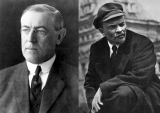 |
C O U R S E L E C T U R E The Wilson-Lenin Moment Notes taken on September 19, 2018 by Edward Tanguay |
•
in 1918, Woodrow Wilson arrived in France to help put together a peace that would put an end to all wars
•
worried whether the Russian Revolution could spread
•
the victors discussed this peace in the shadow of disease and economic troubles
•
personal tragedy behind the scenes
•
Woodrow Wilson's daughter Margaret had gotten the influenza
•
came close to dying in a hospital in Brussels
•
influenza was affecting Wilson's aid, and also French Prime Minister George Clemenceau, British Prime Minister Lloyd George
•
the world leaders were groping for new principles
•
Wilson
•
was a political scientist at Princeton
•
governor of New Jersey
•
the role intellectuals are playing in thinking about public policy
•
these principles were presented in fourteen points
•
had a fear that as old regimes would collapse, radical new regimes would emerge
•
after 1917
•
a concern for the contagion of Communism
•
Lenin promised an end to war by creating a new socialist utopia, for all oppressed people
•
there could be no peace without everyone being beneficiaries of the new order
•
in October of 1917 the old Russian regime capitulated
•
but there was a kind of civil war behind the lines
•
Bolcheviks called for the support from different nationalities in what used to be the Russian Empire
•
Lenin argued that capitalism was the source of the problem for minorities
•
Lenin's communism was attractive to colonies
•
the rest of the world had to respond to this
•
Wilsom saw in Lenin someone who had to be responded to
•
14 points
•
1918
•
what would be the new principles of peace
•
particularly in Russia and Germany
•
we had to prevent Bolshevism from spreading
•
the contagion of Communism
•
open trade
•
open agreement
•
self determination
•
liberal democracy
•
liberal democracies that can trade with each other won't fight
•
Woodrow Wilson's liberal utopia
•
the Leninist and Wilsonian models posed a challenge to the Old World of the 19th century
•
how to reconcile a world of former empires
•
1919: the end of empires all broken up into different nation-states
•
Ottoman Empire
•
Russian Empire
•
German Empire
•
Austria-Hungarian Empire
•
former colonies would enjoy sovereignty
•
but how to govern these
•
many were not ready for self-government
•
became protectorates of the winning side
•
Wilson was an optimist and idealist
•
but he had blind spots
•
disappointed in his own allies inability to share in his principles
•
British and French quarreling
•
French insistence that Germany pay a heavy penalty
•
Wilson saw this as petty
•
faced with national interests
•
Wilson had a series of strokes toward the end of his presidency
•
downplayed it
•
the 30 years of world war
•
1914-1918 was the first phase
•
the Treaty of Versailles was a truce, not a peace
•
it only put a temporary end to the conflicts of Europe itself
•
planted seeds of future conflicts
•
1919-1944 second phase