EDWARD'S LECTURE NOTES:
More notes at http://tanguay.info/learntracker
C O U R S E
Jesus in Scripture and Tradition
Gary Anderson, University of Notre Dame
 |
C O U R S E L E C T U R E The Story of Jacob and his Sons Notes taken on June 13, 2015 by Edward Tanguay |
•
Jacob became the twelve tribes of Israel
•
Leah
•
although the first born, was the less beloved of Jacob's two wives
•
she gave birth to Jacob's first sons Reuben, Simeon, and Levi
•
Rachel
•
in despair over her barren state, provides Jacob with her maidservant Bilhah
•
the idea being that the sons that Bilhah conceives, Dan and Naphtali, will be adopted by Rachel as her very own
•
Leah
•
ever the opportunist and not to be outdone by this stratagem, matches Rachel's Bilhah with her own maidservant Zilpah, and produces yet another pair of sons, Gad and Asher
•
then Leah's womb grows fertile once more and she produces her final set of sons, Judah, Issachar, and Zebulum
•
only at this point when the family seems nearly complete, does Rachel finally conceive and bear her first son, whom she names Joseph, then after a considerable hiatus in time, Rachel conceives a second time, and bears a son by the name of Benjamin
•
tragically, however, she will die while giving birth to this last of her two sons
•
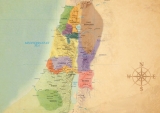
the twelve Sons of Jacob can be placed on the map of ancient Israel
•
two exceptions
•
Levi
•
because this is a priestly clan whose heirs won't have need for land
•
Joseph
•
although his areas are considered to be Ephraim and West/East Manasseh
•
these are the two sons that Joseph had who Jacob adopted as his own, a story told in Genesis 48:1-4
•
the right of a first-born son in the Bible means that he has the right to inherit two parts of the father's inheritance
•
so even though Reuben was the firstborn, Joseph can be seen as being treated as the first born since he gets the two shares from his sons
•
each character in the story of Jacob and his sons represents a geopolitical entity
•
ancient Israelites knew when they heard these names in this story, that they represented real tribes
•
to understand the effect of this story, one could write a story using the names of the Continental United States as the characters in your story
•
you would be free to create any story you wanted
•
but you wouldn't be able to describe the characters in any way you wished
•
since your readers would bring to the story what North Carolina is like, what New York is like
•
they would except that the characters in your story reflect what they know about those states
•
each one of these sons represented a place on the map
•
each one was a tribe that was well known in the land of ancient Israel
•
so as the Biblical writer begins to tell a story using these tribes as names, he has to tell the story in the way that the readers identify with who these tribes functioned in ancient Israel
•
some of the most powerful tribes were the Josephean tribes, Ephraim and Manasseh, and the tribe of Judah, from these tribes Israel's kings and its royal cities emerged
•
in the story about Jacob's sons, these are the two sons that emerge as the most important since these were the two tribes who were the most significant geopolitical entities in the area
•
it can't be accidental that the story of Jacob and his sons is the longest continuous narrative in the Genesis, since it is in this narrative that the writer of Genesis is going to establish what it means to be the people Israel through a story about the twelve tribes, or the twelve characters, who represent the people of Israel