EDWARD'S LECTURE NOTES:
More notes at http://tanguay.info/learntracker
C O U R S E
Buddhism and Modern Psychology
Robert Wright, Princeton University
 |
C O U R S E L E C T U R E What Mental Modules Are Not Notes taken on January 18, 2016 by Edward Tanguay |
•
if the conscious self is not the thing directing behavior and directing thought, then what is doing this?
•
the answer that comes from the modular view of the mind is: nothing in particular
•
this doesn't mean nothing, it just means no single thing
•
rather, there are a number of things called modules
•
they take turns exerting decisive on our thought, our feelings, and behavior
•
there is no conscious self picking the module that gets to be in charge at any given moment
•
it's more like the modules are competing and seizing control of the system in a kind of free-for-all, self-organizing system
•
1980s modern evolutionary psychology
•
critics of evolutionary psychology
•
asking why we needed to talk of the role of genes in shaping the human mind
•
the human mind is a blank slate
•
a general-purpose learning machine
•
response
•
no, you have to have a number of built-in, functional mechanisms
•
support from artificial intelligence
•
AI has learning since the 1950s how hard it is to design into machine functions that we take for granted
•
humans don't spend a lot of time puzzling over how we recognize people's faces, it seems to just happen
•
Swiss army knife metaphor
•
the brain has different modules to perform different tasks
•
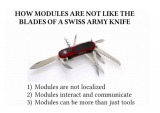
but there are three main ways in which the modular view of the brain is not like a Swiss army knife
•
1. modules are not localized
•
each blade defines a particular space and are individualized
•
modules are not so localized in the brain
•
the facial recognition module is not in one place and no where else
•
it's a distributed network
•
2. modules interact and communicate with each other
•
if you see somebody you know, you also begin to interpret what they mean
•
the semantic interpretation module takes over from the facial recognition module
•
3. modules can be more than tools
•
blades are just tools, if there is no user, they have no use
•
but modules mobilize other modules
•
if we find enough modules and find out how they work and how they work together, we may have a more useful concept of the self than the CEO consciousness