EDWARD'S LECTURE NOTES:
More notes at http://tanguay.info/learntracker
C O U R S E
Formation of the Universe, Solar System, Earth and Life
Henning Haack, University of Copenhagen
 |
C O U R S E L E C T U R E Nuclear Synthesis: The Origins of Elements in Our Solar System Notes taken on November 22, 2014 by Edward Tanguay |
•
nuclear synthesis models come from three separate lines of evidence
•
1. composition of our solar system
•
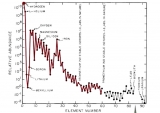
the elemental abundances we have in the solar system
•
the most important of the three type of evidence
•
the atomic structure of atoms
•
nucleus
•
protons
•
neutrons
•
electrons
•
an element's character is defined by the number of protons in the nucleus
•
the number of protons is matched by the number of electrons
•
neutrons add mass but do not determine properties
•
can vary and gives us a number of set isotopes
•
Beryllium example
•
four protons, are set in number
•
five neutrons, can vary in number
•
periodic table
•
gives no indication of how often they occur in the universe
•
hydrogen and helium make up about 99% of the elements that occur in the universe
•
least abundant is uranium
•
the nucleus synthetic models have to explain this relative abundance
•
how do we know this abundance
•
1. meteorites
•
chondrites
•
the most primitive meteorite
•
used to represent the bulk composition of the Solar System
•
not so representative for noble gases (helium, neon, argon, krypton, xenon, and radioactive radon) and some volatile elements
•
how were the elements formed
•
Big-Bang nucleosynthesis
•
1967 Nobel Prize in physics
•
Stellar nucleosynthesis
•
became the standard model which we use today
•
1983 Nobel Prize in physics
•
3 categories of nucleic production
•
1. Big Bang products: Hydrogen, Helium, minor Lithium, Boron, and Beryllium
•
all formed in the Big Bang
•
created in the instant that the universe formed
•
in the first instant you would only have protons and neutrons which begin to combine
•
mainly hydrogen and helium
•
but the Big Bang theory suggested that all the elements were form this way
•
it turns out that there is a fundamental barrier that exists at lithium and Baryllium
•
e.g. as you add another proton to Lithium, you come down to Helium again, which is where Stellar explanation accounts for the elements heavier than lithium
•
2. Stellar fusion products
•
Lithium, Iron, Cobal, Nickel
•
everything up to iron-56 combines in fusion reactions
•
fusion cannot continue beyond iron-56 because you get lower binding forces after that
•
3. products of P, S, and R-nucleosynthesis related to stars and supernovae
•
2. experiments on nuclear reactions under set conditions in the laboratory
•
3. theoretical constraints on possible sites or environments for nuclear synthetic reactions which are imagined within the laboratory