EDWARD'S LECTURE NOTES:
More notes at http://tanguay.info/learntracker
C O U R S E
The Modern World: Global History since 1760
Prof. Philip Zelikow, University of Virginia
 |
C O U R S E L E C T U R E Post-WWI Communism vs. Anti-Communism Notes taken on August 17, 2013 by Edward Tanguay |
•
one of the biggest effects of World War One was the rise of modern communism and the communism vs. anti-communism split was the biggest fault line of the new politics of the 1920s
•
war
•
ruling parties were not able to prevent the war, communism was portrayed as a solution that would prevent war
•
chaos
•
what takes the place of those shattered empires
•
communist revolutions had disciplined cells of organized people ready to act proved to be an advantage in a period of chaos
•
Russia
•
ruling elite is part of a national tradition political movement
•
end of 1800s, Russia is all about emphasizing the nation of Russia, and had an anti-Jewish sentiment
•
Russian people
•
polarized Russian politics: people vs. czar
•
Russia has unusually weak intermediate institutions, nobility has aligned itself with the czar
•
1905 the czar reluctantly created a parliament, albeit a weak parliament
•
you have this empire that, because it has such weak intermediate institutions, also has a relatively weak state apparatus, a decent apparatus for repression, but for administration it was not efficient
•
doesn't have an apparatus to control the resources of the country as efficiently as some of the other countries can
•
basic services break down, e.g. support for widows of war veterans
•
getting food to supplies to the armies
•
by early 1917, the strain was becoming too much
•
end of the empire
•
czar abdicates in early 1917
•
Russian creates a provisional republic
•
organized elections in late 1917
•
basically democratic socialist parties
•
many of the socialist revolutionaries were mainly concerned with land reform
•
they didn't want to take the land away from the rich nobles and give it to the state, they wanted to give it to the poor peasants
•
the Bolsheviks won 30% of vote in 1917
•
February Revolution of 1917
•
Alexander Kerensky (1881-1970)
•
major political leader before and during the Russian Revolutions of 1917
•
served as the second Prime Minister of the Russian Provisional Government until it was overthrown by the Bolsheviks under Vladimir Lenin in the October Revolution
•
provisional government
•
October Revolution
•
Bolsheviks
•
Bolshevism is not about being a mass movement in this era, but basically says, "masses need to be led by a revolutionary vanguard, members must totally submit to party discipline", those who rose to the top such as Lenin had a "tactical single mindedness"
•
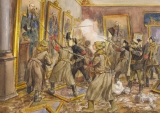
painting: The Pogrom of the Winter Palace (1917), by Ivan Vladimirov
•
the winter palace was where the provisional government had set up its headquarters
•
The French Revolution in 1789 was primarily against the exclusive control of government by hereditary aristocracy, these issues are very much alive and well in Russia in 1917 and 1918.
•
Vladimir Lenin (1870-1924)
•
served as the leader of the Russian SFSR from 1917, and then concurrently as Premier of the Soviet Union from 1922, until his death in 1924
•
family had a long history of activism against he czar
•
a true internationalist revolutionary in his orientation, had intents to overthrow the German government as well even though they helped him
•
1917 arrives in Petrograd
•
Leon Trotsky (1879-1940)
•
Russian Marxist revolutionary and theorist, Soviet politician, and the founder and first leader of the Red Army
•
initially a supporter of the Menshevik Internationalists
•
joined the Bolsheviks immediately prior to the 1917 October Revolution
•
Jewish, committed to the revolutionary
•
The German government in WWI conducted a covert action of putting Lenin into a sealed train car and sending him into Russia "like a virus" to increase unrest of the government and knock Russia out of the war.
•
end of 1917: Bolsheviks take over
•
the Bolsheviks listened to the constituent assembly that was elected and met at the beginning of 1918, but then the Bolsheviks sent them home
•
there were some revolutions against the revolutions, attempts on Lenin's life
•
no quick counter to the Bolshevik seizure of power
•
late 1918, civil war: revolutionary appalled by seizure of private property
•
Bolsheviks control Moscow and Petrograd
•
Bolsheviks want to get Russia out of the war
•
Allies land some troops to try to help the White Army fight the Red Army
•
White Army: loose confederation of Anti-Communist forces that fought the Bolsheviks in the Russian Civil War (1917–1923)
•
Americans very quickly get tired of this support, find it pointless and withdraw
•
allies do not intervene in full strength
•
on July 17, 1918 the Bolsheviks killed the czar and his family to show that there was no bridge going back to the Romonov dynasty
•
Soviet government survives but at times their future was unstable
•
1921-22: the situation settles down and the Bolsheviks gain tighter and tighter control
•
European revolutions and counter-revolutions
•
Hungary, Germany, Poland, Kronstadt
•
Hungary: communist revolution succeeds
•
anti-communism
•
Communism was so threatening with its war against established religion, against private property, and its agenda to overthrow society so thoroughly, there arose a huge and popular reaction against it. Fear of communism became a powerful force of renewal for the conservative movements and a rallying point as powerful or more powerful than communism itself.
•
liberalism
•
in the violent fights that broke out between communism and anti-communism, the liberalism which had grown strong in the late 19th century suffered
•
the idea of liberalism ultimately survives in many countries: Germany survives the after-effects of the Bolshevik revolution and set up a republic
•
liberalism does not have a stance of having a strong government or a strong army, but the opposite and in times like the early 1920s, that's a liability
•
the morphing of political movements after WWI
•
national tradition
•
1900s they believe in kings and emperors, by 1920s their influence is gone
•
moving to fascism
•
new political movement: fascism
•
drew from revolutionary socialists, national conservatives and national traditionalists
•
Benito Mussolini (1883-1945)
•
Italian politician, journalist and leader of the National Fascist Party, ruling the country as Prime Minister 1922 to his ousting in 1943
•
ruled constitutionally until 1925, when he dropped all pretense of democracy and set up a dictatorship that ruled the country until 1943
•
In the 1920s what started taking the place of a spectrum of political beliefs was a new movement called fascism, a hybrid which attracted those who believed in the purity of the nation and the defense of national traditions, it added some of the top-down, modernizing supporters of the national conservatives, especially people who had grown intolerant of democracy and party politics. The astounding characteristic of fascism, however, was that it also attracted many of those from the complete opposite side of the political spectrum, the revolutionary socialists who also wanted a strongly nationalist agenda. There's no better example for fascism and the mixed political DNA it represented than Benito Mussolini, who himself had been a revolutionary socialist in fact an editor of one of the leading socialist newspapers in Italy, yet throughout WWI, becomes a fervent supporter of Italy in the war, and ends up founding the fascist movement in Italy which ultimately became hostile to the socialist movement from which Mussolini originally came.
•
new political movement: communism
•
members coming from revolutionary socialists (those who weren't moving toward fascism)
•
began organizing itself internationally
•
liberals
•
in the 1920s it is no longer fashionable to talk about the struggle for markets and natural resources among the liberal democracies
•
anti-imperialist movements
•
1800s: keep the foreigners out (e.g. England, France, Dutch)
•
after WWI: take over the embryonic state the foreigners have created, e.g. India
•
uses vocabulary from the foreigners themselves, e.g. picking up the ideology of democratic revolutions, against governments which rule without the consent of the people
•
also picking up vocabulary of communist movement
•
India
•
Rabindranath Tagore (1861-1941)
•
a Bengali polymath (expertise in many different subject areas) who reshaped his region's literature and music
•
first non-European to win the Nobel Prize in literature
•
his seemingly mesmeric personality, flowing hair, and otherworldly dress earned him a prophet-like reputation in the West
•
emphasized the spiritual quality of rural India, the idea of the ashram, a spiritual hermitage in which yoga, music study or religious instruction is practiced
•
Mahatma Gandhi (1869-1948)
•
preeminent leader of Indian nationalism in British-ruled India
•
1920: three-piece suits, British lawyer, a perfect Edwardian gentleman, but then switched to dress in more of a traditional and simpler Indian style
•
practices law among the Indian ex-patriots in South Africa
•
becomes an opponent to British discrimination and eventually to British rule, believes Indians need to empower themselves
•
his notion of anti-imperialism is a fusion of both western ideas and Indian ideas, believes there should be a nation-state called India organized along Western lines but needs to be infused with spiritual qualities expressed by writers like Tagore
•
in 1910s Indian congress would have like to have the dominion status that Canada and Australians had
•
places not scarred by WWI
•
USA
•
foreign news: New York Times, October 17, 1919: lots of stories on the first page about battles of the Reds vs. Whites in Russia
•
local news: many stories about communist scares in the United States
•
problems between management and labor
•
stories about strikers
•
news stories about communists and communism are numerous
•
Barcelona 1919-1923
•
general strike is successful
•
striker organizing into military groups
•
1923: Spanish government becomes a military dictatorship in response to communist uprisings
•
Shanghai 1925-1927
•
1925 anti-foreign unrest, imperial policemen fire into a crowd
•
Chiang Kai-Shek (1887-1975)
•
organizes the non-communists against the communists
•
influential member of the Kuomintang (KMT), or Nationalist Party, and was a close ally of Sun Yat-sen
•
took Sun's place as leader of the KMT when Sun died in 1925
•
1949 retreated his government to Taiwan, ruled till his death in 1975