EDWARD'S LECTURE NOTES:
More notes at http://tanguay.info/learntracker
C O U R S E
The Ancient Greeks
Andrew Szegedy-Maszak, Wesleyan University
 |
C O U R S E L E C T U R E The First Persian War and the Battle of Marathon Notes taken on May 1, 2015 by Edward Tanguay |
•
Cyrus II of Persia [SIGH-rus] (576–530 BC)
•
conquered Croesus [KREE-sus] and took over Lydia
•
530 BC killed in battle
•
Magi {MAY-jigh] took over for a short time
•
6th century BC followers of Zoroastrianism
•
Darius I [dah-RIGH-us] 550-486 BC
•
ruled for long time: 522-486 BC
•
modern day Iran
•
Bahiston inscription [bah-HIS-ston]
•
"the place of god"
•
shows the King Darius
•
text details his conquests
•
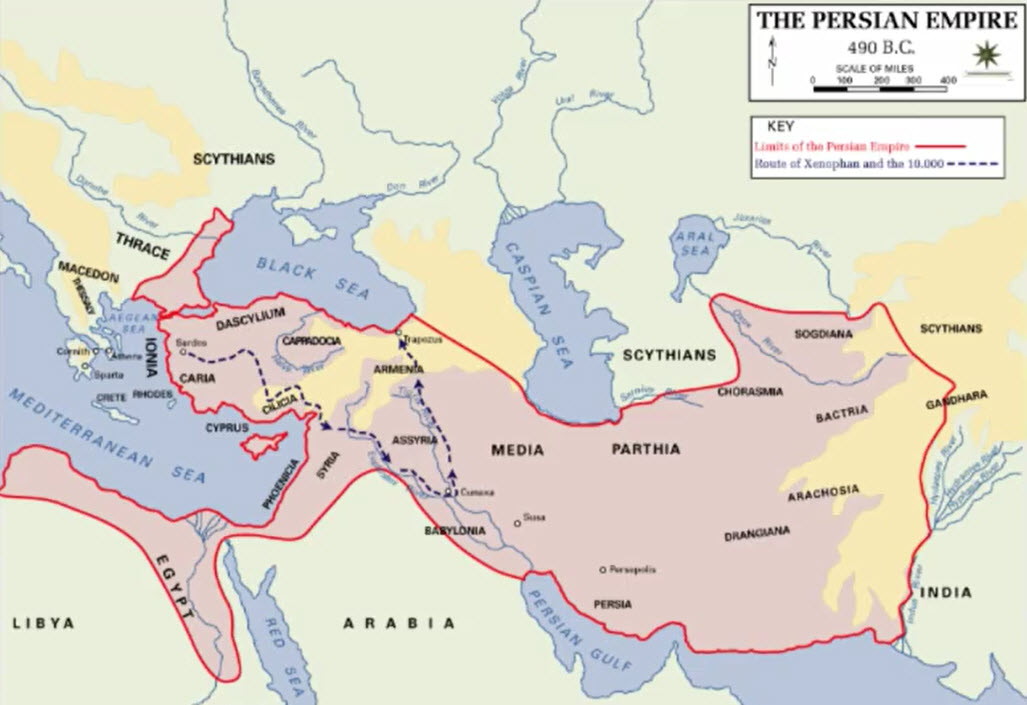
presided over a massive empire
•
From the Thracian coast to western part of India
•
well-developed bureaucracy
•
enormous among of treasure
•
became king
•
Herodotus wrote extensively of him
•
was going to come into conflict with the Greeks
•
a very great size difference
•
Greece
•
508 BC: just established a democracy under Cleisthenes
•
King Cleomenes [clee-OH-men-eez] of Sparta had been forced to withdraw
•
506 BC: wanted to reassert his influence in Athens
•
others had designs of moving into Athens as well
•
Boeotia [bee-OH-shah] centered around Thebes
•
Euboea [yoo-BEE-ah] (island) centered around Chalcis
•
they had heard of political turmoil going on there
•
internal dissension made Spartans turn back
•
Athenians created Hoplite armies which drove back the Boeotians and others
•
young democracy proved itself
•
Athens made deal to get financial help from Persian Satrap [SAY-trap]
•
gave Persians earth and water
•
cultural misunderstanding
•
Persia took this as a sign that the Greeks were giving themselves over as subjects
•
Ionian cities had been brought under Persian control
•
had to start to pay taxes
•
Persians had installed their own vassal governments there
•
499 BC Ionian revolts
•
Aristagorus
•
tyrant of the city of Miletus
•
a key player during the early years of the Ionian revolt against the Persian Achaemenid Empire [ah-KEE-men-eed]
•
goes to Sparta and asks to help
•
they say to no
•
goes to Athens
•
they agree to help
•
because Hippias was in Persia and Athens feared him returning
•
fleet of 20 ships
•
with other ships from Eretria [air-RHET-ree-ah]
•
burn Croesus' ancient capital of Sardis
•
Persians had felt that their alliance with Athens had been betrayed
•
King Darius was furious
•
Persia got prepared for war
•
494 BC the Ionian revolt was crushed
•
city of Miletus was sacked and burned
•
as revenge for the destruction of Sardis
•
but Darius also wanted to punish the Athenians directly
•
Athenians and Spartans kill the Persian ambassadors who come to ask for earth and water as a way to show loyalty
•
against protocol
•
ambassadors usually are protected in order to enable negotiations
•
491 BC Persians invade
•
490 BC make it to the mainland
•
first target is Eretria [ah-REE-tree-ah]
•
they destroy it
•
just off the coast of Attica
•
reaction in Athens was of stunned panic
•
Hippias was among the Persian forces
•
Herodotus tells story about Hippias
•
has a dream that he made love to his mother
•
believes this means he will rule in Athens
•
the Oedipal dream can be understood as significant because Marathon had been chosen by Hippias' father, Peisistratos, for a landing which opened the way for a victorious march on Athens and the establishment of tyranny
•
Herodotos intended to give a psychoanalytic explanation of why Hippias, who obviously knew the terrain to perfection, made a bad choice in advising the Persians
•
Hippias wanted to do as well as his father, but his wish took the character of an Oedipal wish to outdo the father and possess the mother, with subsequent guilt and self-defeat
•
Herodotus puts worth on dreams in his Histories in this way
•
490 BC: Battle of Marathon
•
Athenians mount a Hoplite defense
•
go out from the city to meet Persian
•
Miltiedes (550 – 489 BCE) [mil-TIGH-i-deez]
•
member of a great, old family
•
put his best troops not on the front line
•
but on side where they can attack the Persian flanks
•
casualties
•
Greeks: 192
•
Persians: over 6000 Persians
•
this was a win against all odds for the Greeks
•
Pheidippides sent as messenger back to Athens
•
reasons Greeks won
•
1. Hoplite armor was better
•
Persian armor tended to be a linen corslet
•
a shield made out of wicker
•
shown in art on pottery
•
depictions of Greeks vs. Persians
•
showing hoplite tactics
•
2. Greeks fought in tighter positions
•
3. Greeks were also fighting for the liberty of their homeland
•
a fight for freedom against despotism
•
Marathon was an ideological battle
•
John Stuart Mill
•
"As an event in English history, the Battle of Marathon is more important than the Battle of Hastings."
•
has an unusual status in world battles
•
but at Marathon, the Persians had been beat and were angry
•
the Persian wars were by no means over