EDWARD'S LECTURE NOTES:
More notes at http://tanguay.info/learntracker
C O U R S E
A History of the World since 1300
Jeremy Adelman, Princeton University
 |
C O U R S E L E C T U R E The Panic of 1907 Notes taken on September 3, 2017 by Edward Tanguay |
•
the late 19th century saw increasing troubles in the core European nations, and in the United States
•
the economy of the Victorian boom began to falter
•
1873-1896 global and near-global recessions
•
had the capacity to skip from society to society
•
the weaknesses of the model of interdependence began to show
•
interdependence affected the ability of governments to stop the problems from spreading
•
this was not new but became more rapid at the end of the 19th century
•
John Maynard Keynes (1883-1946)
•
British economist whose ideas fundamentally changed the theory and practice of macroeconomics and the economic policies of governments
•
August 1914, wrote essay in Economic Journal
•
worried about the world's ability to survive a major crisis, a prescient article
•
the world economy faced two kinds of problems:
•
1. the gold standard that had served as a ballast for the system, restricted the ability of governments to deal with currency pressures, was very rigid
•
2. private banks were so large in proportion to the amount of money in circulation, that a run on any bank could cascade into a full-blown financial crisis
•
if one bank failed, it could bring down the entire system
•
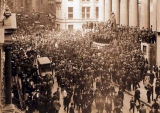
The Panic of 1907
•
a United States financial crisis that took place over a three-week period starting in mid-October, when the New York Stock Exchange fell almost 50% from its peak the previous year
•
panic occurred, as this was during a time of economic recession, and there were numerous runs on banks and trust companies
•
began with a few bond failures
•
collapse in commodity prices
•
started with the price of copper that was being traded internationally
•
the United Copper Company tried to corner the copper market
•
the loans that the banks issued to the company failed
•
then the banks became unstable
•
led to a run on stocks
•
pressure on the American dollar
•
led to the failure of the Knickerbocker Trust Company—New York City's third-largest trust
•
there was no central authority to intervene to put an end to the panic
•
it fell to the magnates of Wall Street to solve it
•
J. P. Morgan (1837–1913)
•
the panic might have deepened if he hadn't intervened
•
pledged large sums of his own money, and convinced other New York bankers to do the same, to shore up the banking system
•
put together a major infusion of liquidity, became a "lender of last resort"
•
pumped in 23 million dollars in the New York stock exchange
•
bought up New York City bonds
•
led to a series of discussions on ways to prevent these kinds of financial panic situations in the future
•
1913 the approval of the Federal Reserve Act
•
considered if free markets needed support to prevent them from ruining their own fortunes