EDWARD'S LECTURE NOTES:
More notes at http://tanguay.info/learntracker
C O U R S E
Formation of the Universe, Solar System, Earth and Life
Henning Haack, University of Copenhagen
 |
C O U R S E L E C T U R E The Origin of Solar Systems Notes taken on May 30, 2016 by Edward Tanguay |
•
while solar systems are based on hydrogen and helium, they also also likely to include all the elements of the period table
•
many generations of dying stars have injected freshly synthesized matter into interstellar space
•
how can this widely scattered matter be used to form dense solar systems for planets
•
if the matter was evenly distributed throughout the universe, this would be a hopeless task
•
fortunately, due to the force of gravity, matter is concentrated in galaxies such as our own Milky Way galaxy
•
within the galaxies, most of the matter is concentrated in molecular clouds
•
these are enormous clouds, even when we observe them from as far away as the Earth
•
yet because they are also very faint, they also remain almost invisible to the naked eye
•
the Orion constellation which lies close to the terrestrial equator
•
the three bright stars are known as Orion's belt
•
if we zoom in and increase the brightness, the underlying cloud becomes visible
•
Horsehead Nebula
•
Orion Nebula
•
this is a star-forming region
•
we cannot observe how our own solar system formed, but observing places like this, we can deduce how solar systems form in general
•
the size of molecular clouds can be measured in units of light years
•
molecular clouds look passive but they are highly dynamic
•
stellar winds push the gas around at speeds up to several hundred km/s
•
even at these speeds, it would take a millions years to traverse the width of these clouds
•
we use computer simulations to fast-forward this process
•
can run the simulation for two million years
•
newborn stars light up within the cloud as the simulation runs
•
but we need to compress it by many orders of magnitude to form a solar system
•
sometimes gas gets compressed to a point that gravity is stronger than the gas pressure
•
the result is a runaway collapse resulting in star formation
•
a famous example of star formation is seen in the Hubble image of the Eagle Nebula
•
intense stellar winds have created a bubble in the cloud
•
the stellar winds not only push the gas further and further away from the star through a process known as photoevaporation
•
it also compresses the gas to point where a gravitational collapse is triggered
•
this is exactly what we need to form a new star
•
once a dense core is formed, it's gravity field will start to grow as attracts more and more gas and thus further increases a gravity field, which is called accretion
•
each of these tentacle-like structures contains a new star at the tip
•
eventually the gas will clear around the new star, accretion will cease, and the star will begin its life as an independent object
•
as the gas collapses toward the growing star, it will rotate faster and faster, much like water running out of a bathtub
•
the accretion prevents all of the gas from accreting directly to the star
•
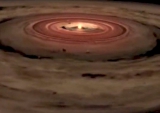
instead, a rotating disc of gas and dust is formed around the young star
•
it is from these discs that planets are formed
•
this explains why all of the planets in our solar system orbit in the same plane around the sun
•
early solar systems
•
matter from the cloud is falling in toward the disc
•
most of the mass is drifting inwards toward the star
•
concentrated toward the mid-plane, we find solids of different sizes
•
near the start, milimeter-size particles known as CAI's condense out of the gas
•
Calcium/Aluminum-rich inclusions
•
calcium and aluminum condense at very high temperatures
•
meteorites have CAIs, e.g. white, irregular inclusions in a rock
•
further away from the star we find silicate spheres known as chondrules
•
the disc is composed of dust and gas
•
near the center there are no ice crystals, further out there are ice crystals
•
as a result, outer planets grow faster and bigger
•
the gas in the disc was only present for a few million years
•
the outer planets beyond the frost line grew big enough to capture gas from the disc while it was still there
•
became gas giants
•
inside the frost line, smaller rocky or terrestrial planets formed, e.g. Mercury, Venus, Earth and Mars
•
accretion of the planets
•
a protoplanetary core
•
accretes dust, condrules and CAIs
•
in the last stages of accretion there were only a few large planetary formations
•
one of the last of these later formations which accreted to the Earth was probably Mars-sized
•
resulted in a collision of cataclysmic proportions
•
the presence of our Moon was likely a consequence of this event