EDWARD'S LECTURE NOTES:
More notes at http://tanguay.info/learntracker
C O U R S E
Roman Architecture
Diana Kleiner, Yale University
 |
C O U R S E L E C T U R E Opus Caementicum and Opus Incertum Notes taken on January 23, 2014 by Edward Tanguay |
•
concrete (Opus Caementicum [kigh-MENT-tee-kum]) changed the concept of architecture for the Romans
•
a shift from tradition architecture to innovative
•
tradition Roman architecture
•
Temple of Portunus
•
derivative that looked back at Greek and Etruscan religious architecture
•
Etruscan
•
tall podium
•
deep porch
•
single staircase
•
Greek elements
•
made of stone
•
Ionic order on columns
•
concrete
•
concrete was used already in the Temple of Portunus (1 BC), but only in the podium, you can't see it
•
can sustain great weights
•
placed in the podium for support
•
Romans at this time begin to see that concrete has an ability to transform Roman architecture
•
Roman concrete was different than today's concrete
•
composite of various natural elements that becomes a mass when mixed with water, and hardens into a very strong substance, much harder than any of its ingredients on its own
•
components
•
stone rubble
•
liquid mortar
•
lime, sand, and pozzolana, a volcanic substance
•
used in the early 2nd century BC
•
concrete is not cut or quarried, it is cast into molds
•
can be cast in any shape, at least any shape that a carpenter can build with wood
•
freed the Roman architect from the confines of a rectilinear architecture inherited from the Etruscans and the Greeks
•
greatest concrete structure: Pantheon
•
we can compare an Etruscan tomb which attempted to do the same thing, using stone
•
wasn't terribly successful, even had to put a stone column in the middle for support
•
two problems with concrete
•
has to be protected from moisture
•
is less attractive than stone
•
solved these two problems in the same way
•
when still wet, attached stone to it
•
large blocks or small rocks pressed into the concrete
•
Temple of Vesta at Tivoli
•
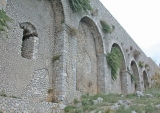
Opus incertum (uncertain masterwork) [in-KAIR-tum] protected the concrete with small stones
•
Sanctuary of Fortuna Primigenia at Palestrina
•
Palestrina is south of Tivoli
•
used a stone-facing Opus incertum
•
used often in the 2nd and 1st centuries BC
•
over time the choice of facing changed
•
under the Roman emperor Nerva, there was a revolution in Roman architecture
•
new facing material: brick
•
the attractiveness of brick