EDWARD'S LECTURE NOTES:
More notes at http://tanguay.info/learntracker
C O U R S E
A Brief History of Humankind
Dr. Yuval Noah Harari, The Hebrew University of Jerusalem
 |
C O U R S E L E C T U R E Why Did Other Human Species Become Extinct? Notes taken on August 24, 2013 by Edward Tanguay |
•
the significant revolution in the status of humans in the ecosystem came only after the appearance of our own species, Homo sapiens
•
appeared between 300,000 and 200,000 years ago in Africa
•
by 150,000 years ago, East Africa was populated with Homo sapiens which looked much like us
•
around 70,000 years ago, some of these Homo sapiens left East Africa and reached the Middle East and began spreading over the Eurasian land mass
•
when these Homo sapiens arrived, most of Eurasia was already populated with other species of humans, e.g. Homo neanderthalensis (Europe), Homo denisova (Siberia), and Homo soloensis (Java), this is one of history's biggest and most important questions: why did these other species of humans become extinct, and what role did Homo sapiens play in their extinction?
•
THEORY #1: the interbreeding theory
•
as sapiens spread around the world, they bred with other species and humans today are the result
•
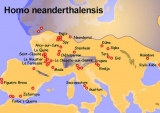
in Europe: encountered neanderthals
•
more muscular, better adapted to European climate, had bigger brains, used tools, fire, and good at hunting all kinds of animals
•
often depicted as brute and stupid cavemen
•
genetic evidence shows that at least some of the Neanderthals had fair skin
•
Sapiens and Neanderthals bred and formed a mixture of sapiens and neanderthals resulting in European humans
•
THEORY #2: the replacement theory
•
a story of incompatibility and perhaps of genocide
•
no interbreeding between Sapiens and Neanderthals
•
different mating habits
•
different body odors
•
little sexual interest in each other and children would be infertile
•
when Neanderthals died out, their genes died with them
•
sapiens became the last remaining species of human on the earth
•
this theory suggests that all living humans today are not a mixture but are simply Homo sapiens
•
in recent decades, this was the common theory
•
the debate between these two theories is not just an academic, but political of course
•
70,000 years is not enough time for significant genetic changes to occur
•
if the replacement theory is correct, this means that all humans living today have the same DNA
•
would mean that the differences between Africans, Europeans, Chinese are negligible
•
if the interbreeding theory is correct, then there are differences between human races which go back hundreds of thousands of years
•
e.g. Chinese might have Homo erectus genes which Africans don't have
•
this would be political dynamite
•
2010 Neanderthal genome mapped
•
from Neanderthal bones
•
compared this genome to people living nowadays
•
it turned out that 4% of genes of people living in Europe and the middle east are Neanderthal genes
•
this means that there are people living today who have ancestors who were Neanderthals and Denisova
•
also it was shown that 6% of genes of people living in China are Denisovan genes
•
so the interbreeding area has some truth to it, but it does not mean that the replacement theory is not true
•
if there were a complete mixture and no replacement then the percentages would be more in the range of 40%-60%
•
the common theory now is that Homo sapiens intermingled some with other human species but in no way did they merge completely, probably because of the sheer differences between them
•
big question: were Homo sapiens separate species from the other human species or the same
•
given the new DNA evidence, it is clear that Homo sapiens and Homo neanderthalensis were not separate species since they were obviously able to produce fertile offspring, however, it would be a mistake to view them as populations of the same species. The truth is that biological reality is not black and white, but complex with important gray areas in the way we catalog and classify animals.
•
*** the common theory now is that at one point Neanderthals and Sapiens were able to mate and did mate, but they both continued to evolve on separate paths not sharing their subsequent mutations until they became two completely separate species which could no longer mate, this is thought to be about 50,000 years ago
•
the question still remains: why did Neanderthals vanish?
•
Theory #1: Neanderthals became extinct because Homo sapiens slowly out-competed them for food
•
e.g. 40,000 years ago Sapiens from the Middle East arrive in a Balkan valley in modern-day Greece of Bulgaria where Neanderthals have been living for countless generations, these new Sapiens have to eat, they hunt the local deer and eat the local mushrooms, but these are the same animals the Neanderthals live on
•
Sapiens were already more sophisticated than the Neanderthals and hence Neanderthals were left with less and less food, a few Neanderthals joined and mated with Sapeins which is how 4% of their genes are now in our DNA
•
Theory #2: Neanderthals became extinct because the competition for food flared up into violence, war and possible genocide
•
this is quite a likely scenario since tolerance has not been a typical human characteristic throughout history. When you look at human activity throughout history, you can find many instances of intelligence, sophistication, and ingenuity, but examples of wide-spread tolerance is for the most part an extremely recent invention of human beings. Even well into the 20th century, human history is littered with terrible examples in which even small differences in skin color, dialect, or religion has been enough to prompt one group of sapiens to go about exterminating other groups of sapiens. It is highly unlikely, therefore, that an ancient species of human being would be tolerant at all of a completely different human species.
•
Theory #3: a mix of both of the above two theory: out-competition and targeted violence
•
one of history's what-if questions: what if many species of humans had survived?
•
what kind of political and religious structures would have emerged with several human species?
•
the disappearance of the Neanderthals changed the way Homo Sapiens think about themselves
•
it's hard for us to conceive that there were other human species and easier to create a gap between humans and the rest of the animal kingdom
•
when Darwin suggested in the mid-19th century that humans were just another kind of animal, people were outraged
•
speculation: perhaps this is why Homo sapiens wiped out the other species: they were too similar to ignore but too different to tolerate
•
what we know for certain: when Homo sapiens arrived at certain places on earth, other species of humans went extinct
•
Homo soloensis went extinct 50,000 years ago, just as Homo sapiens arrived at the island of Java
•
Homo denisova went extinct about 41,000 years ago, after Homo sapiens began to spread into Asia
•
The Neanderthals disappeared about 30,000 years ago, about 10,000 years after Homo sapiens arrived in Europe
•
The last dwarve humans vanished from Flores island about 12,000 years ago
•
(by contrast Homo erectus disappeared 143,000 years ago which puts them in a different category, perhaps even the ancestors of Homo neanderthalensis and Homo sapiens)
•
timeline:
•
50,000 BC: the various species of humans (Homo sapiens, Homo neanderthalensis, Homo denisova) were at the point where they all went their separate evolutionary ways becoming completely distinct species which could no longer mate to produce fertile offspring
•
50,000 BC: Sapiens were already quite different from other human species in their cognitive and social abilities