EDWARD'S LECTURE NOTES:
More notes at http://tanguay.info/learntracker
C O U R S E
Greek and Roman Mythology
Dr. Peter Struck, University of Pennsylvania
 |
C O U R S E L E C T U R E Myth, History, and Virgil Notes taken on December 20, 2013 by Edward Tanguay |
•
jumping from Greek to Rome, a very different culture
•
we learn that the Romans borrow all of the Green myths and change the names and adopt the stories for themselves
•
there is some truth to that
•
it is more accurate to say that both Greeks and Romans were working from a common pool of Mediterranean materials which they each put their own spin on
•
it's not quite right to look at the Romans as being derivative of the Greeks
•
in Homer there was a limited amount of historical material you could reference
•
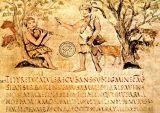
Virgil (70BC-19BC)
•
ancient Roman poet of the Augustan period
•
known for three works: Eclogues (or Bucolics), the Georgics, and the epic Aeneid.
•
Virgil is writing myth within history
•
doing something different than what we have seen up till now
•
we have lots of evidence around for the historical context in which Virgil is writing
•
a different kind of context: myth is now being made within historical time
•
a higher degree of difficulty to ascertain what is historical fact and what is myth he created to build a narrative of Romans
•
he can't just tell a story in ahistorical cloudiness, he has to anchor it to well-known facts and stories of the time
•
myth has been a way to understand identity
•
especially in the case of Odysseus with individual identity
•
identities getting dissolved before our very eyes as in the case of Oedipus and Pentheus
•
Pentheus
•
banned worship of Dionysus, did not allow women of to join rites, so Dyionysus caused women to tush to Mount Cithaeron in a Bacchic frenzy, so Pentheus imprisoned Dionysus thinking him a follower but chains fell off, Dionysus lured Pentheus to spy on Bacchis rites disguised as a woman, daughters of Camus see him in a tree, thought him a wild animal, tear him apart, mother puts his head on a stick and carries it back to town, then recognized him.
•
with Virgil we look at identity through a new lens: the identity of a nation as a whole
•
not what it means to be an individual, but what it means to be a Roman
•
no poet up to know was try to craft a kind of Greekness for his, but this is Virgil's aim
•
we may be able to see it in their stories but they weren't crafting this consciously
•
indentity for an individual is above all a biological continuity
•
connections to past
•
but what about for a nation?
•
not biological, although Virgil spins it in that way
•
mostly myth, narrative, myths are the very stuff that national identities are made up of, takes the place of biology for individuals
•
Scylla and Charybdis
•
twin dangers
•
one on each side of a straight
•
Between Scylla and Charybdis
•
Charybdis is sometimes the daughter of Poseidon and Gaia, very gluttonous
•
Odysseus faced both Charybdis and Scylla
•
twin dangers of history
•
1. it is just a fact that happened
•
the past is a very place, what counts as just the facts, it depends on which facts they pick
•
it has to be relevant to some we, it guides the process of history
•
we have to weed out practically all of it
•
how we edit depends on a number of normative questions
•
2. history is made up by the winners
•
certainly people who have political power have an ability to make their version of events the authoritative one
•
history is not just fabricated and its not just there
•
if you want to understand a history you have to consider the process of editing
•
1. accuracy: are the events happening
•
2. fairness: is their representation fair
•
e.g. you could make the point that in WWII there were atrocities on both sides, but this doesn't turn out to be a fair representation of what happened
•
it doesn't represent the largeness and complexity of the events
•
when studying Virgil, you have to ask:
•
1. is he accurate?
•
2. is he fair, is he representing Romans in a fair way?