EDWARD'S LECTURE NOTES:
More notes at http://tanguay.info/learntracker
C O U R S E
Human Evolution: Past and Future
John Hawks, University of Wisconsin
 |
C O U R S E L E C T U R E The Molecular Clock Notes taken on February 10, 2014 by Edward Tanguay |
•
phylogeny [figh-LAH-jin-nee]
•
understanding of the relationship between species
•
the relationship between species is a fundamental aspect of how evolution happened
•
when we add genetics to phylogeny, it gets complicated and involves math
•
how we use phylogeny to understand when certain species shared common ancestors with each other
•
humans, chimpanzees, gorillas, orangutans
•
four species of living homenoids
•
macaques
•
not a part of the group that includes the other homenoids
•
cladogram shows clades, or branches of an ancestral tree
•
today we use cladograms to understand the study of biology
•
allows you to understand the relationships between organism
•
genetics
•
genetics by and large reflect the phylogeny of the groups
•
humans are most genetically similar to chimpanzees
•
humans and chimps are next most genetically similar to gorillas
•
we're more distantly related in genetics to macaques
•
1962 Linus Pauling and student Emil Zuckerkandl
•
researched which amino acids there were in a protein hemoglobin in different kinds of organisms
•
seemed to show that the number of differences in the amino acid sequences seemed to reflect the time that those organisms shared a common ancestor according to the fossil record
•
e.g. humans and apes are 1 amino acid different, yet humans and horses are 17 amino acids different
•
proposed the theory "the molecular clock"
•
differences in amino acids in hemoglobin are accumulating at a regular rate over time
•
if this were true, we could determine how long two species shared a common ancestor as a separate way than using the fossil record
•
i.e. we could look at how different they are and determine that they shared a common ancestor beginning at a certain time in the past
•
1992: research, Wendy Bailey
•
studying a part of the DNA called the psi-eta-globin
•
a part of the genome which is near the betaglobin gene which is part of hemoglobin
•
in some ancient organisms psi-eta-globin may have been functional but in all living primates, it has lost its function, it doesn't make any product anymore
•
why would something that has no function exist and persist in primate genomes?
•
our genomes are full of genes that once worked in ancient organisms but stopped working at some point in our evolutionary history
•
some primates share a deactivation of the gene that creates vitamin C, some animals have no problem creating vitamin C, but primates have to get vitamin C from external sources
•
e.g. GULOP which still exists in the human genome
•
the further we move away from humans into other primates, the higher the difference of the gene sequence for psi-eta-globin
•
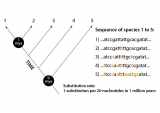
the percentage differences between the genes allows us to put age estimates on when the branchings occurred
•
e.g. humans and macaques in terms of their DNA are about twice as different than humans and orangatans are
•
this is what is referred to as the molecular clock
•
molecular clock is an assumption that genes change at a constant rate but there may be mutations which cause them to converge on each other
•
to estimate times from these percentages, you have to know how often genetic changes happen, to further increase accuracy, you have to root this to the fossil record
•
e.g. Sivapithecus [shee-vah-PITH-i-kuss] is a genus of extinct primates that may have been the ancestor to modern orangutans, fossil record indicates that it lived about 12 million years ago