EDWARD'S LECTURE NOTES:
More notes at http://tanguay.info/learntracker
C O U R S E
A Brief History of Humankind
Dr. Yuval Noah Harari, The Hebrew University of Jerusalem
 |
C O U R S E L E C T U R E European Empires, Science, and Capitalism Notes taken on January 23, 2014 by Edward Tanguay |
•
what united science and European imperialism was the urge to discover and conquer
•
at first the empires supported science mainly in terms of geographical explorations
•
however, soon followed medicine, botany, history, linguistics studies
•
even studies that seemed useless were supported by the European empires because you could never really know what might be useful
•
19th century, botanists who studied the folk medicines and witch doctors of South American tribes, discovered a treatment for malaria from the tree of Cinchona, which was later used in treating malaria when exploring Africa
•
British in India
•
first lets look what the Muslims did when they conquered India
•
they were not particularly interested in archeology or history
•
when the British came, they
•
archeologists to study Indian history anthropologists, zoologists
•
rare Indian spiders and butterflies
•
studied languages of India
•
discovering of the Indus valley civilization
•
destroyed around 2000 BC
•
no Indian knew anything about it until the British came
•
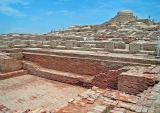
1922 discovered Mohenjo-daro
•
deciphering of Egyptian hieroglyphics
•
the last person who could read hieroglyphic text probably died in the first millennium AD, in the Roman Empire when Egypt was ruled by the Romans
•
when the Arabs conquered Egypt in the 7th century, they made no attempt to decipher hieroglyphics
•
when the Mamluks conquered Egypt in the 13th century, they also made no attempt to decipher hieroglyphics
•
when the Turks conquered Egypt in the 16th century, they also made to serious attempt to decipher hieroglyphics
•
in 1791, Napoleon invaded Egypt, when his soldiers were busy building a fort at a place called Rosetta, they were digging to make a fort, they discovered a stone with three texts on it: one in Greek, one in Demotic, and one in Hieroglyphics
•
as was usual, Napoleon's army was accompanied by scientists, 160 experts from different disciplines to study Egypt, and when this stone was discovered, it was quickly brought to the attention of these scientists, who realized this might be the key to deciphering the lost writing of ancient Egypt
•
two years later in 1801, the French army was defeated by the British, and as part of the surrender terms, the French had to give up the Rosetta stone to the British
•
British allowed scholars from all over Europe to try to decipher the text on this stone
•
after 20 years, by ironic justice, a French scholar Jean-Francois Champollion in 1822
•
enabled archeologists to read other texts and begin exploring the ancient world of Egypt in detail
•
science owes a large debt to the contribution of European empires
•
European empires didn't support everything, they supported mostly those projects which they thought could be of use to them
•
not only practically but ideologically
•
history, archeology, biology
•
scientists gave their support to the empires because
•
they supported scientific research
•
they were seen as engines of progress
•
they would bring science and reason to other parts of the world
•
European imperialism is complicated: it clearly brought both war, famine, racism, slavery, and exploitation, as well as medicines, roads, schools, freedom, liberty, and in general a higher standard of living
•
1764 British conquered Bengal
•
richest province of India
•
new British rulers were interested in making themselves rich
•
their economic policy in part caused the Great Bengal Famine between 1769 and 1773
•
10 million people died
•
the issue of European imperialism is complicated
•
very powerful
•
controlled very large areas of the world
•
did so many things that they provide plenty of evidence for any argument one wants to make about them
•
due to the alliance with science, the European empires wielded so much power and their activity in so many areas of the world led to so many changes, you can find plenty of evidence of European empires being both extraordinarily beneficial or destructive to the rest of the world, but what we know is that the European empires allied with science for the large part created the world as we know it today including the ideologies which we use in order to judge them
•
without the contribution of science, it is hard to believe that Europeans could have conquered the world, but the conquerors returned the favor by providing scientists with information and protection, by supporting all kinds of strange and fascinating projects and by spreading the scientific way of thinking all over the world
•
and without imperial support, it is doubtful that modern science could have progressed very far
•
and it was capitalism which provided the financial means for both doing science and building empires
•
without this financial support, Columbus could never have reach America, James Cook could never have reached Australia, and Neil Armstrong could never have reached the moon