EDWARD'S LECTURE NOTES:
More notes at http://tanguay.info/learntracker
C O U R S E
From the Big Bang to Dark Energy
Hitoshi Murayama, University of Tokyo
 |
C O U R S E L E C T U R E The Milky Way and Its Black Hole Notes taken on March 8, 2016 by Edward Tanguay |
•
as you look far away in the universe, you are looking into the past
•
International Space Station
•
only very recent that humans have developed technology to have a station outside the earth
•
floating above the Earth at an altitude of 375 kilometers
•
the diameter of the Earth is 12,000 kilometers
•
suggests that moving out away from the Earth is not a very easy thing to do
•
travel to the moon
•
384,400 kilometers
•
Kaguya
•
nickname for SELENE (Selenological and Engineering Explorer)
•
launched on September 14, 2007
•
picture:
•
went to the other side of the moon
•
took pictures of Earth rise
•
because distances are so large in space, we use time to describe how far away objects are
•
light takes 1.3 seconds to reach the Moon
•
Moon is 1.3 light-seconds away
•
the Apollo astronauts put a mirror on the Moon
•
we can shoot a laser to it and it returns 2.6 seconds later
•
Sun
•
1.5 10^8 kilometers away
•
8.3 light-minutes away
•
Hayabusa
•
an unmanned spacecraft developed by the Japan Aerospace Exploration Agency (JAXA) which returned a sample of material from a small near-Earth asteroid named 25143 Itokawa to Earth for further analysis
•
20 light-minutes away from the Earth (more than two times the distance to the Sun)
•
the command sent to the probe to deploy the Minerva lander arrived to late, since it took 20 minutes to get there
•
there is a 40-minute lag for making decisions of how the probe should interact with its environment
•
it had to decide as much as it could on its own
•
Neptune
•
four light-hours away
•
Voyager
•
human-made object that is the farthest from Earth
•
16-light-hours away
•
we are still communicating with it
•
closest star
•
Proxima Centauri
•
4.2 light-years
•
Voyager will have to travel for over 10,000 years to get to Proxima Centauri
•
Milky Way galaxy
•
we are in a galaxy which is a disc and when we look at the Milky Way we see the disc from the inside
•
we are 28,000 light-years away from the center of the galaxy
•
it's only 1500 light-years thick
•
our solar system is revolving around the center of the our galaxy
•
at a speed of 220 km/s
•
something is pulling us to the center of the galaxy
•
we know this to be a black hole
•
with infrared light we can see through the dust and debris in space to see the motion of stars at the center of the galaxy
•
something is pulling a star, and after it passes through, it speeds on quickly
•
it takes 20 years for a star to orbit around this very heavy object
•
by studying the motion of these stars, you can determine how massive the object is
•
the answer is staggering: the object in the middle of the Milky Way galaxy is four million times heavier than our Sun
•
nothing can be that heavy except for a black hole
•
black hole at center of the Milky Way
•
four million times our solar mass
•
other galaxies have heavier black holes
•
it can consume objects including gas around it
•
even the speed of light is not enough to escape the force of gravity from the black hole
•
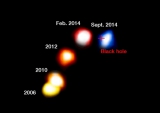
just before gas enters the black hole, it flashes in light