EDWARD'S LECTURE NOTES:
More notes at http://tanguay.info/learntracker
C O U R S E
The Modern World: Global History since 1760
Prof. Philip Zelikow, University of Virginia
 |
C O U R S E L E C T U R E America's Entry into World War II Notes taken on April 7, 2014 by Edward Tanguay |
•
Critical gambles at the end of 1941
•
the grand strategy for the U.S. up to 1941 was "Germany First", so why did the war with Japan begin?
•
America hoped to deter Japan from attacking
•
put sanctions on Japan constraining oil and vital resources
•
wanted to keep the Japanese from attacking the Soviet Union, which succeeded (!)
•
America prodded Japan making it clear that if they meddled in the Pacific, they would have to deal with America
•
America hoped this would deter Japan from attacking America, but it didn't
•
what went wrong
•
America underestimated the fatalism of the Japanese leadership
•
GAMBLE #1: Japan attacks Pearl Harbor
•
Germans then declared war on the U.S.
•
had promised the Japanese they would do this
•
Japanese were victorious in the beginning of the war but not so much America had to fight Japan first and then Germany
•
GAMBLE #2: Germany gambled that it would rapidly defeat the USSR, but this went wrong
•
Germany vs. Russia was an extraordinary conflict
•
consider how modern armies in 1941 moved
•
army division was about 12,000 men
•
to move, they basically had to "go on a camping trip" for weeks, for months, carrying all their materials
•
had backups behind the armies to take care of the front
•
the reality of a "camping trip" is you are tired, you don't get much sleep, you're cold and think about hot food, shelter, getting out of the rain, day in and day out, plus, occasionally, people are trying to kill you
•
then there is the challenge of keeping up with the supplies off-road
•
German army of 1941 used millions of horses, but much of the supplies had to be hauled over land by humans
•
occasional explosives sending shards of metal in every direction
•
it was dangerous to be on foot, but to be in an armored vehicle, you were an easy target
•
Germans are making extraordinary headway against a surprised Soviet army
•
but their challenge is to great
•
but the Germans push beyond their limits
•
1941: into Ukraine, east past Crimea, Hitler's generals want one more desperate attempt to capture Moscow
•
but winter 1941 sets in
•
soldiers are scattered all over the countryside
•
they are very vulnerable
•
December 5, 1941: Soviets hit Germans very hard
•
by early 1942 Germans' position is worse than if they had just dug in for the winter
•
GAMBLE #3: Germans and Japanese can pin the Americans down in the Pacific so that American military power won't make a signficant difference in the rest of the world
•
this gamble fails but it was a close call
•
Japanese victory at Pearl Harbor is substantial but incomplete because:
•
1. American aircraft carriers were not in the harbor but out of at sea, and they became the trump cards during the war
•
2. Japan didn't get the oil
•
for the Americans to supply their ships in the Pacific, they can't carry the oil from California
•
so they use Hawaii as a giant fueling station, but the Japanese didn't bomb these facilities, although that would have been crippling for the United States
•
Japan's choices after early 1942
•
Japan had an advantage
•
options going into the war
•
1. big attack to occupy Hawaii, driving the U.S. back to California
•
2. attack Australia
•
3. raid around the Indian ocean and attack England in India
•
4. attack Soviets
•
they decide to do options 1-3
•
by choosing all three, they overextended themselves
•
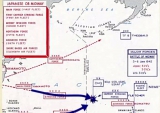
the Midway operation was key
•
Japanese were defeated in a close call
•
American in an intelligence coup was able to read messages of what the Japanese would do before it happened
•
Japanese 4 aircraft carriers against 3 aircraft carriers
•
American destroyed all 4 carriers and lost only one
•
by 1942 all powers are now locked in a global, total war