EDWARD'S LECTURE NOTES:
More notes at http://tanguay.info/learntracker
C O U R S E
A New History for a New China, 1700-2000
James Z. Lee, The Hong Kong University of Science and Technology
 |
C O U R S E L E C T U R E Social Mobility and the Examination System in Late Imperial China Notes taken on July 24, 2013 by Edward Tanguay |
•
Max Weber (1864-1920)
•
German sociologist, philosopher, and political economist whose ideas influenced social theory, social research, and the entire discipline of sociology
•
studied the religions of China with regard to the apparent non-development of capitalism in the corresponding societies, as well as to their differing forms of social stratification
•
Imperial China
•
major dynasties
•
Qin Dynasty (221BC-206BC)
•
Han Dynasty (206BC-220AD)
•
...
•
Tang Dynasty (618-907)
•
...
•
Song dynasty (960-1279)
•
Yuan Dynasty (1271-1368)
•
Ming Dynasty (1368-1644)
•
Qing Dynasty (1644-1911)
•
social service examinations
•
one of the many gifts of Imperial Chinese civilization to world civilization besides paper, gun powder, and Chinese cuisine, was a system of objective social service testing, which in the Chinese imperial system provided approximately half of the government positions: about half of the positions were given to people based on heredity and wealth, and half were given to people based on examination success.
•
three-step ladder of success
•
500,000 shengyuan
•
16,000 juren / 35,000 gongsheng
•
4,000 jinshi
•
all 51,624 have their name on display in the Beijing Confucian Temple
•
elite social mobility
•
shengyuan
•
1% per of adult males
•
10% of examination-level educated adult males
•
juren/gongsheng
•
0.1% of adult males
•
1% per of adult males
•
jinshi
•
0.01% of adult males
•
0.1% per of adult males
•
data collection
•
done mainly by Ping-ti Ho in the 1960s
•
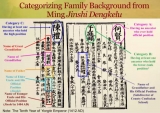
go information on social background of the people who passed these exams
•
category A: no degree holder in the last three generations (90%)
•
category B: one or more shengyuan in last three generations (9%)
•
category C: one or more high degree than shengyuan in last three generations (1%)
•
his findings shows that for the first 500 years, most Jinshi had no family background of ancestors having been Jinshi
•
China in the 14th century was far more mobile than other countries from then up into the 20th century
•
Jiang Qin (2012) results showed also that it was ability more than wealth of family which generally led to success