EDWARD'S LECTURE NOTES:
More notes at http://tanguay.info/learntracker
C O U R S E
A History of the World since 1300
Jeremy Adelman, Princeton University
 |
C O U R S E L E C T U R E 1871: Germany Becomes a Nation Notes taken on December 8, 2015 by Edward Tanguay |
•
Japan ushered in a new age for the Japanese people
•
but in the course of their expansion began to transform the geo-political theater of East Asia
•
with tremendous consequences for the 20th century
•
1894-95: First Sino-Japanese War
•
became almost like a template of what would happen in the rest of the world
•
Germany, late 19th century
•
like Japan, national integration depends on the formation of state power
•
often in its assertion over neighbors
•
empire is used as a concept and instrument for nation building
•
a model of recovering from fragmentation, a collection of feudal statelets,
•
the remnants of an empire now being brought together over the course of the 19th century
•
particularly in the wake of the French invasions into Germany during the Napoleonic wars
•
and in some ways borrowing from Napoleon for examples of legal modernization
•
like the Japanese
•
Japan borrowed modern ideas from the United States
•
Germany borrowed ideas from England and France
•
consolidating the state, creating an illusion of a shared German space which in some sense had never existed before
•
but arguments were made to the opposite of this
•
that Germany was Protestant, while there were actually many Catholics and Jews
•
Germany had an identity that was somehow counterpoised to the other dominating national identity of Europe, France
•
became a long-standing conflict
•
sowed the seeds for the outbreaks in the 20th century
•
the Habsburgs looked upon the German empire as a threat to their strategic interests
•
Germany faced challenges that were very close to them
•
Japan at least had the advantage of being separated by large bodies of water
•
Otto von Bismarck (1815-1898)
•
a shrewd and calculating politico
•
was the strong man of the single regimes of the German confederation of states
•
managed to promote the idea of a Kaiser, an imperial ruler who would issue his dominion over all of German-speaking peoples from a capital, a national capital, in Berlin
•
Germans like Japanese, to build nation, relied upon
•
schools, universities
•
language campaigns
•
newspapers, magazines
•
to transcend the local ideas of Prussia, Bavaria
•
promoting new business elites
•
looking for a national market
•
the birth of emerging industrialists
•
many of the firms are still the companies that dominate the economic landscape of economic Germany today
•
also needed a way of cajoling these elites into participating in unification
•
representation in the national political entities like the national parliament, the Reichstag
•
local wars
•
Prussian army became the important instrument for creating a new national model of integration
•
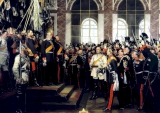
laid the foundations for a national war with France, 1870-71
•
this war was decisive
•
Prussia spanked the French
•
it was a deeply humiliating war for the French
•
put the French national identities into another one of its seismic crises
•
emboldened the idea that the Prussian military could pull the German nation together
•
a decisive moment of unification for the new German nation
•
after 1871, Germany began to consolidate more and more led but Bismarck
•
first Chancellor Bismarck
•
power radiating out to a unified Germany from Berlin
•
the system of Iron and Blood
•
iron = exemplified the toughness and resilience of the new nation
•
blood = sacrifice
•
unification of Germany altered the power balance of Europe
•
created a new model of territorial rivalry inside the heart of Europe
•
with much more lethal potential
•
Germany and Japan almost like echoes of each other
•
phenomenal examples of the power of nationalism to construct new state systems that could use its resources at the expense of old systems adjacent to them
•
political, military, and economic powerhouses
•
not unlike a teenage boy who returns to school from summer vacation grown and all bulked up with muscles, as the French and the Chinese were to discover