EDWARD'S LECTURE NOTES:
More notes at http://tanguay.info/learntracker
C O U R S E
Our Earth: Its Climate, History, and Processes
David Schultz, University of Manchester
 |
C O U R S E L E C T U R E Measuring Geologic Time Notes taken on June 19, 2015 by Edward Tanguay |
•
history of the Earth
•
events in billions of years ago
•
4.57 Earth's formation (Hadean Eon)
•
3.8 first evidence of oceans (Archaen Eon)
•
2.5 oxygen-rich atmosphere (Proterozoic Eon)
•
0.542 explosion of fossils (Phanerozoic Eon)
•
0.065 dinosaurs go extinct (Phanerozoic Eon - Cenozoic Era)
•
0.0002 first hominids
•
0.000022 maximum extent of last Ice Age
•
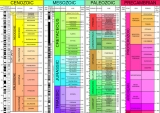
classification scheme for geological time, from largest to smallest
•
speak in these terms since these dates are rough estimates based on various ways of determining how long ego events occurred
•
eons
•
eras
•
periods or systems
•
epochs or series
•
stages
•
abbreviations
•
Ma (mega annum)
•
million years
•
Ga (giga annum)
•
billion years
•
four eons
•
PRECAMBRIAN supereon:
•
[1] Hadean Eon - 4570 Ma
•
named after Hades, or the under world
•
formation of Earth and Moon
•
molten earth surface
•
formation of earliest crust
•
[2] Archaen Eon - 3800 Ma
•
[ar-KEE-an]
•
oceans formed
•
single-celled animals
•
geologic record documents these single-celled fossils their structures they left behind called surmatelites
•
process of plate tectonics was just beginning
•
low oxygen concentration in air
•
[3] Proterozoic Eon - 2500 Ma
•
increasing oxygen concentration in the atmosphere
•
periods of glaciations including a period in which the Earth may have been entirely covered in ice
•
multicellular life began evolving
•
Ediacaran Period (635-542 Ma)
•
first multicellular life
•
first appearance worldwide of somewhat complicated trace fossils
•
[4] Phanerozoic Eon - 542 Ma
•
increasing complexity of multicellular life
•
the colonization of life from the ocean onto the land of plants and animals
•
the eon in which complex life began to flourish
•
but also with periodic extinction events that almost ended life on earth
•
1. Paleozoic Era (542,000,000 - 251,000,000)
•
Cambrian Period - 542 Ma
•
rapid diversification of lifeforms known as the Cambrian explosion
•
produced first representatives of all modern animal phyla
•
high proportion of lagerstätte sedimentary deposits with exceptional preservation
•
where "soft" parts of organisms are preserved as well as their more resistant shells
•
therefore we understand Cambrian biology better than some later periods
•
Ordovician Period - 485 Ma
•
life continued to flourish
•
end of period marked by a significant mass extinction
•
invertebrates, namely molluscs and arthropods, dominated oceans
•
fish, the world's first true vertebrates, continued to evolve, first jawed fish
•
land life had yet to diversify
•
Silurian Period - 444 Ma
•
diversification of jawed and bony fish
•
life also began to appear on land in the form of small, moss-like, vascular plants which grew beside lakes, streams, and coastlines
•
small terrestrial arthropods (insects, spiders)
•
but terrestrial life would not greatly diversify and affect the landscape until the Devonian
•
Devonian Period - 419 Ma
•
free-sporing vascular plants began to spread across dry land, forming extensive forests which covered the continents
•
fish reached substantial diversity during this time, leading the Devonian to often be dubbed the "Age of Fish"
•
Carboniferous Period - 358 Ma
•
terrestrial life was well established
•
amphibians were the dominant land vertebrates
•
one branch would eventually evolve into reptiles
•
Permian Period - 298 Ma
•
the diversification of the early amniotes into the ancestral groups of the mammals, turtles, lepidosaurs and archosaurs
•
2. Mesozoic Era - 250 Ma
•
Triassic Period - 250 Ma
•
began in the wake of the Permian–Triassic extinction event, which left the Earth's biosphere impoverished
•
it took into the middle of the period for life to recover its former diversity
•
the first true mammals
•
Jurassic Period - 200 Ma
•
land dominated by dinosaurs
•
supercontinent Pangaea had begun rifting into two landmasses
•
created more coastlines and shifted the continental climate from dry to humid
•
many of the arid deserts of the Triassic were replaced by lush rainforests
•
first birds and earliest lizards
•
Cretaceous Period - 145 Ma
•
oceans and seas were populated with now-extinct marine reptiles, ammonites and rudists
•
dinosaurs continued to dominate on land
•
new groups of mammals and birds, as well as flowering plants, appeared
•
ended with a large mass extinction, the Cretaceous–Paleogene extinction event, in which many groups, including non-avian dinosaurs, pterosaurs and large marine reptiles, died out
•
3. Cenozoic Era (65,000,000 - today)
•
Paleogene Period - 65 Ma
•
Paleocene Epoch - 65 Ma
•
brackets two major events in Earth's history: (1) the demise of non-avian dinosaurs, giant marine reptiles and much other fauna and flora, and (2) the Paleocene–Eocene Thermal Maximum, a geologically brief interval characterized by extreme changes in climate and carbon cycling
•
Eocene - 56 Ma
•
includes the warmest climate in the Cenozoic Era when little or no ice was present on the planet, but ends in an much colder climate
•
ended in a major extinction event called the Grande Coupure (the "Great Break" in continuity) or the Eocene–Oligocene extinction event
•
Oligocene - 33 Ma
•
an important time of transition, a link between the archaic world of the tropical Eocene and the more modern ecosystems of the Miocene
•
Neogene Period - 23 Ma
•
Miocene - 23 Ma
•
cooled in a series of ice ages
•
apes arose and diversified becoming widespread in the Old World
•
ancestors of humans split away from the ancestors of the chimpanzees
•
Pliocene - 5.3 Ma
•
cooled down from the Miocene temperatures
•
Quaternary Period - 2.5 Ma
•
Pleistocene - 2.5 Ma
•
recent period of repeated glaciations
•
Holocene (11,700 - 1800)
•
current warm period
•
(proposed) Anthropocene (1800 - present)
•
epoch in which humans are affecting the climate
•
mnemonic for eons and eras of geological time containing life forms on Earth
•
Proterozoic Eon
•
(E)VERY - Ediacran Period - 635 Ma - single-celled organisms
•
Phanerozoic Eon
•
Paleozoic Era - (FISH) - 542 Ma
•
(C)AMEL - Cambrian Period - 542 Ma - multicelled diversity explosion
•
(O)FTEN - Ordovician Period - 485 Ma - diversified ocean life
•
(S)ITS - Silurian Period - 444 Ma - early jawed and boned fish
•
(D)OWN - Devonian Period - 419 Ma - the age of fish
•
(C)AREFULLY - Carboniferous Period - 358 Ma - dominant amphibians
•
(P)ERHAPS - Permian Period - 298 Ma - mammal ancestral groups
•
Mesozoic Era - (DINOSAURS) - 250 Ma
•
(T)HEIR - Triassic Period - 250 Ma - extinction and recovery, therapsids and first mammals
•
(J)OINTS - Jurassic Period - 200 Ma - age of reptiles, first birds
•
(C)REAK - Cretaceous Period - 145 Ma - new mammals, ended with dinosaur extinction
•
Cenozoic Era - (MAMMALS) - 65 Ma
•
Paleogene Period - 65 Ma
•
(P)ERHAPS - Paleocene Epoch - 65 Ma - dinosaurs gone, changes in climate
•
(E)FFECTIVE - Eocene Epoch - 56 Ma - warmest, no ice on planet
•
(O)ILING - Oligocene Epoch - 33 Ma - transition from tropical to modern ecosystems
•
Neogene Period - 23 Ma
•
(M)IGHT - Miocene Epoch - 23 Ma - humans and chimpanzees split
•
(P)ROLONG - Pliocene Epoch - 5 Ma - climate cooled
•
Quaternary Period
•
(P)ERFECT - Pleistocene Epoch - 2 Ma - repeated glaciations, humans evolved into present form
•
(H)EALTH - Holocene (11,700 - ca. 1800) - current warm period, major human civilizations
•
(A)GAIN - (proposed) Anthropocene (ca. 1880) - humans altering the climate