EDWARD'S LECTURE NOTES:
More notes at http://tanguay.info/learntracker
C O U R S E
The Great War and Modern Philosophy
Nicolas de Warren, KU Leuven University
 |
C O U R S E L E C T U R E Eucken's Interpretation of Fichte Notes taken on March 26, 2016 by Edward Tanguay |
•
August 25th, 1914
•
three weeks after the Germans invaded Belgium
•
German troops set fire to the city of Leuven
•
destroyed the University Library
•
including collection of over 300,000 books and manuscripts dating back to Medieval times
•
provoked international indignation and outrage
•
British Prime Minister Ashquith
•
"The burning of Leuven is the worst thing the Germans have yet done. It reminds one of the Thirty Years War."
•
British archaeologist Sir Arthur Evans
•
who had excavated palace at Knossos in Crete
•
"May I be allowed to voice horror and profound indignation at the Prussian holocaust of Leuven."
•
the destruction of the library became a symbol of the war
•
between civilization and its barbaric opponent: the German culture
•
a damning judgment against Germany given its superlative achievements in philosophy, arts, and literature in the 19th century
•
German intellectuals mobilized to articulate and defend the German cause
•
on the even of the First World War, German philosophy and German philosophers enjoyed an unprecedented international reputation
•
Rudolf Eucken (1846-1926)
•
in his day a very well known philosopher
•
today forgotten
•
had received the Nobel Prize for Literature in 1908
•
till today the only German philosopher to be awarded this honor
•
1911 invited to lecture at London, Oxford, Harvard, and Columbia
•
1912-1913 remained in U.S. at professor of Harvard
•
traveled on East Coast giving lectures
•
there were Eucken associations and Eucken reading clubs
•
The Idea of 1914
•
a distinctive interpretation of the war in favor of a German conception of freedom and nationhood
•
"Die Träger des deutschen Idealismus" (1915)
•
with expressed purpose of bolstering the moral of German soldiers in the trenches
•
became the principal exponent of a type of philosophical engagement in the war called Kriegsphilosophie
•
the mobilization of philosophical discourse, the way it becomes weaponized as the pursuit of war by other means
•
the way it tries to understand the deeper philosophical or metaphysical meaning of the War
•
Eucken and the intellectual atmosphere at the beginning of the war
•
1. the idea of 1914
•
2. the symbol of the German philosopher Johann Gottlieb Fichte (1762-1814)
•
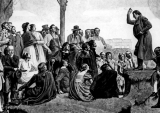
in 1913, a special painting was commissioned to represent the legendary "Addresses to the German Nation", Fichte's speeches he gave a few years after the catastrophic defeat of the Prussian army at the hands of Napoleon in 1806
•
we see Fichte, his arm raised high, giving his speeches to the full spectrum of the German population
•
speeches are meant to realize and unify the German nation in time of war
•
in 1813 and once again in 1914
•
Fichte was seen as the philosopher of the German nation
•
this symbol became increasingly important over the course of the First World War
•
in 1908, Fichte had issues a new addition of Fichte's Addresses to the German Nation
•
he underlying Fichte as the educator of the German nation
•
it was precisely this formation of a national spirit through a philosophical act of speech that was first instituted by Fichte in the Napoleonic Wars that becomes repeated by Eucken in his own speeches and his own wartime writings
•
Eucken during the war
•
built upon Fichte's popular Kriegsphilosophie
•
gave lectures at university and town halls throughout Germany
•
wrote a number of books during the war
•
1915 "Die Träger des deutschen Idealismus"
•
dedicated to his sons who are both serving in the field
•
writes the book as a narrative of German philosophy with its pinnacle in German idealism
•
the centerpiece will be an interpretation of Fichte
•
as a way to bolster the moral of the troops in the trenches, book is a paperback and meant to be portable
•
one can imagine soldiers in the field putting it in their backpacks and going to the front clear about what they are fighting for which is nothing less than the spirit of the German nation
•
three central ideas in Eucken's war philosophy
•
1. reconstruction and endorsement of the main conception of the German nation as proposed by Fichte in his Addresses to the German Nation
•
argument centers on establishing the notion of nation as the German people, "das Volk"
•
the German people is in turn defined in terms of its faith or love for a "world historical mission"
•
a kind of special mission that the German people have the realize
•
the realization of this mission is the idea of the German nation
•
based on the idea that human existence cannot be authentic without having some authentic love or belief in something, and the object of this belief has to be something that's eternal
•
so it takes up a Platonic idea that the object of true love is something that doesn't pass in time, but that is eternal
•
the mission of the German people is to realize something eternal
•
two terms to describe this:
•
1. Verkörperung
•
to give body, to physically or materially realize something, an incarnation, which has also a religious connotation
•
the mission of the German nation is the incarnation of the eternal
•
2. Befestigung
•
a clear military term
•
entrenchment or citadel
•
has its origins in Luther: "the Befestigung of God"
•
so the mission of the German nation is also to defend the eternal
•
2. the important of sacrifice for the nation
•
German vocabulary has only one word ("Opfer")to be the victim of something, as well as to the object of sacrifice
•
the ambiguity of the German term is that it can mean someone who a victim of something as well a someone who may even voluntarily want to be the sacrifice of something
•
what Eucken empasizes is that in order to realize the German nation, which itself realizes a certain notion of the eternal, individuals have to sacrifice their individuality to this mission, that is become victims to it.
•
this gives a special meaning to the experience of death
•
the death of the individual is needed in order to embody an idea of the nation which itself has eternal existence
•
give meaning to his book: "Die Träger des deutschen Idealismus", to carry and support it
•
the death of individuals on the battlefield will itself be the support through which something like the "German nation" will enter into existence and be eternal
•
the death of the individual is a kind of gift that he gives to the nation so that the nation can find its fulfillment
•
"the doubling of the German spirit"
•
a peculiar idea of Eucken's
•
if the German nation is going to realize eternity
•
and if this eternity gives substance to the German people
•
then the German spirit operates to what we might call a double rotation
•
1. the realization of the German nation allows for the eternal to enter into history
•
and this requires an expansion of Germany into history which legitimizes the expansion of Germany into the world
•
2. this is not only a shaping of the world, but a deepening of the German spirit itself, "Innerlichkeit zu bilden"
•
3. the notion of the existential conception of war
•
for Eucken, Germany is not fighting for political or economic causes, but for an eternal cause