EDWARD'S LECTURE NOTES:
More notes at http://tanguay.info/learntracker
C O U R S E
Phenomenology and the Conscious Mind
Dan Lloyd, Trinity College
 |
C O U R S E L E C T U R E The Experience of the Now Notes taken on April 22, 2017 by Edward Tanguay |
•
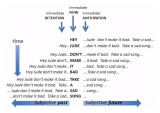
you start listening to a song, e.g. the Beatles song, "Hey Jude"
•
after it starts, the beginning is sinking into the immediate past
•
each moment of the song is, in time, a separate and discreet event
•
each word is a separate event
•
when we hear the word "Hey", every bit of us pulls towards the next word in the song, "Jude"
•
as the two words unfold, we have both anticipation and retention
•
the anticipate and retention is a part of our experience
•
it's as if we can hear the approach words but not in a sensory fashion
•
primal impression
•
the middle piece between subjective past and subjective future
•
the now is temporally extended to include the whole song or parts of the song
•
our present experience spreads to past and future and that is all contained in each and every present moment of consciousness
•
dimensions
•
the first three are the familiar spacial dimensions
•
the fourth is physical time, or clock time
•
Husserl is the pioneer of the fifth dimension
•
like the fourth dimension, the fifth dimension affects all the contents of consciousness
•
you can anticipate a thought, experience its presence, and retain it as it fades
•
all consciousness is consciousness of something
•
in our phenomenological zoo, we find every kind of object: real, unreal, concrete, abstract, precise or vague
•
we find every kind of psychological attitude toward those objects
•
perceive, believe, imagine, remember, anticipate, hope, fear, etc.
•
some of these objects and attitudes are especially important
•
the computer at which you sit is not like the unicorn you imagine, i.e. it's real
•
but your psychological attitude toward both it is one of belief
•
although there are many insights to be found in the fun house of phenomenology, in the end, we exit to the serious business of real life
•
but if the fun house is consciousness itself, how can we leave it?
•
real things like computers and tables are elements in conscious awareness
•
our experience of computers and tables are different than our experience of unicorns and superheroes, but what is that difference?
•
much of Shakespeare probes the nature of the real and the unreal
•
Macbeth in particular explicitly questions reality throughout the play
•
as he prepares to kill the king of Scotland, he envisions a hallucination hovering in space
•
Is this a dagger which I see before me, The handle toward my hand? Come, let me clutch thee. I have thee not, and yet I see thee still. Art thou not, fatal vision, sensible To feeling as to sight? Or art thou but A dagger of the mind, a false creation, Proceeding from the heat-oppressed brain? I see thee yet, in form as palpable As this which now I draw.
•
the dagger Macbeth sees certainly looks real, but raises many questions
•
being a good phenomenologist, he reaches out to test some multi-sensory confirmation, but multi-sensory confirmation fails, "I have these not, and yet I see thee still"
•
his dagger lacks the continuity of a real thing that persists through time
•
the seeming dagger unlike a real thing, fails to enter into a cause-and-effect relation with other things, including Macbeth's hand as he reaches for the hallucinated weapon
•
there is no interpersonal agreement about the existence of the dagger
•
continued reality testing condenses the subjective into the objective
•
which will sort hallucinations from reality quite reliably