EDWARD'S LECTURE NOTES:
More notes at http://tanguay.info/learntracker
C O U R S E
Imagining Other Earths
David Spergel, Princeton University
 |
C O U R S E L E C T U R E Dwarf Planets and Beyond, Getting a Feel for Cosmic Distances Notes taken on June 2, 2014 by Edward Tanguay |
•
solar system
•
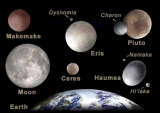
dwarf planets besides Pluto
•
Eris
•
most massive of the dwarf planets
•
1% of earth's mass
•
discovered in 2005
•
has one moon Dysnomia
•
Ceres
•
the largest object in the asteroid belt, which lies between the orbits of Mars and Jupiter
•
a ball of rock and ice 950 km in diameter, containing a third of the mass of the asteroid belt
•
the largest asteroid, and the only dwarf planet in the inner Solar System
•
it was the first asteroid to be discovered, on 1 January 1801 by Giuseppe Piazzi in Palermo, at first considered to be a planet
•
the unmanned Dawn spacecraft is scheduled to arrive at Ceres in early 2015
•
named after the Roman Goddess of Agriculture
•
Haumea
•
located beyond Neptune's orbit
•
discovered in 2004
•
named after Haumea, the Hawaiian goddess of childbirth
•
its extreme elongation makes it unique among known dwarf planets, nonetheless, its gravity is believed sufficient for it to have relaxed into hydrostatic equilibrium, making it a dwarf planet
•
Makemake
•
perhaps the largest Kuiper belt object (KBO)
•
has no known satellites, which makes it unique among the largest KBOs and means that its mass can only be estimated
•
discovered on March 31, 2005
•
the name derives from Makemake in the mythology of the Rapanui people of Easter Island
•
many others
•
nearest star is Alpha Centauri
•
4.37 light years from the Sun
•
277,600 AU
•
actually a binary star system
•
this pair of stars have an 80 year orbit around a common center, and are about as close to each other as Saturn and the Sun
•
how long would it take to travel from Earth to Mars at 20,000 km/hr (Voyager 1 is traveling about 61,000 km/hr)
•
if the planets didn't move it would take about 100 days
•
since both are orbiting the sun, you would have to travel in a transfer orbit, so it would take about 200 days
•
Voyager 1
•
as of September 2013, Voyager 1 was at a distance of 18.7 billion kilometers (125.3 AU) from the Sun, and escaping the solar system at a speed of about 3.6 AU per year
•
this year Voyager 1 space craft crossed into interstellar space
•
the earth
•
distance from sun
•
150 million kilometers
•
1 AU, or astronomical unit
•
some planets are 10 or 20 AU from their sun
•
Saturn: 9 AU - 10.1 AU from Sun
•
the Kepler telescope has been exploring planets of other stars and has found planets even a 0.3 AU from their sun
•
planets
•
stars twinkle and planets don't
•
brightest start is Sirius
•
Greek for "glowing"
•
actually two stars, Sirius A and Sirius B, distance between them varies between 8.2 and 31.5 AU
•
Venus always close to the Sun
•
will always see it soon after sunset or right after sunrise
•
Jupiter is always very bright
•
often seen directly overhead
•
with binoculars, you may be able to see four moons
•
first discovered by Galileo
•
Sumerians referred to the "stars" that moved "wanderers", these were planets
•
because planets are so much closer
•
moon
•
cratered structure
•
fascinated Galileo
•
craters reflect the history of the moon
•
old view of solar system
•
Pluto was seen as a planet but had an odd orbit, actually crossing in closer than Neptune at times
•
the current system is much more messy, Pluto is just one of 50 known dwarf planets that make up the Kuiper Belt
•
Pluto is not that special anymore, actually smaller than Eris and about the same size as 2003 EL61
•
Eris: 67.69 AU
•
Pluto: 39.54 AU
•
dwarf planets are discovered through a concept called parallax
•
displacement or difference in the apparent position of an object viewed along two different lines
•
90377 Sedna
•
three times as far from Sun as Neptune
•
surface is largely a mixture of water, methane and nitrogen ices
•
surface is one of the reddest in the Solar System
•
Sirius (Dog Star) - bright in northern hemisphere
•
Alpha Centuri - bright in southern hemisphere
•
parallax is used to measure distances to distant stars as well
•
the parallax that a typical star would have is about:
•
one arc second
•
1 parsec
•
3.26 light years
•
206,000 astronomical units
•
most of the solar system is mostly space
•
Neptune is 30 AU
•
nearest star is 206,000 AU
•
our galaxy the Milky Way
•
center of our galaxy forms a bulge
•
distance to the center of our galaxy is about 8000 parsecs or 24,000 light years
•
our galaxy is one of many galaxies
•
the width of our galaxy is about 30,000 parsecs, or 90,000 light years
•
most of the young stars are forming in the spiral arms