EDWARD'S LECTURE NOTES:
More notes at http://tanguay.info/learntracker
C O U R S E
Buddhism and Modern Psychology
Robert Wright, Princeton University
 |
C O U R S E L E C T U R E The Default Mode Network Notes taken on October 19, 2014 by Edward Tanguay |
•
much recent research has been about the brain and meditation
•
increases gamma wave activity
•
increases white matter in the brain
•
it's difficult to know what findings are significant for you or to even understand what these mean
•
one finding is more meaning:
•
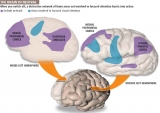
when people meditate, the default mode network gets less and less active
•
default mode network
•
active when we are not doing anything in particular
•
usually when we are not going anything in particular, we are actually doing quite a bit
•
thinking about ourselves
•
regretting something in the past
•
worrying about something in the future
•
fantasizing
•
this network of brain regions seems to get activated when we are doing these self-referential processing tasks
•
basically your mind wandering
•
it takes your mind somewhere other than where you are
•
in a spacial sense
•
you won't be focused on your immediate environment
•
in a temporal sense
•
studies where people whose minds are wandering, when they are interrupted, are usually thinking of something in the past or the future
•
when you mindfully mediate, e.g. follow the phrase "be here now", the areas of the brain that make up the default mode network becomes quieter
•
when you meditate, the default mode network does not always surrender quietly, thoughts keep coming up
•
the thought of an e-mail
•
something that needs to be done
•
any tangential idea
•
these thoughts are the develop mode network asserting itself
•
it's job is to take advantage of free time
•
if you are not engaged in some task that requires focus
•
playing a sport
•
writing a report
•
looking at someone and wandering if they are someone you know
•
calming down the default mode network is a necessary step to reach a state of mindfulness meditation
•
there is a second sense in which you have to escape self-involvement
•
a true test of mindfulness would be to think of someone you don't like and see if you can look at the feeling of dislike and not get caught up in it, not let it carry your train of thought away
•
it's a common aspiration to carry mindfulness out of the meditation hall into the real world
•
the attitude of non-reactivity
•
one reason this is hard is that life is full of things you do react to
•
studies indicate that people have no problem assigning affective characteristics to objects, even seemingly neutral objects such as:
•
refrigerator, sock, cloud
•
our minds will actually begin wandering on these concepts connecting them to other thoughts, this is the job of the default network mode
•
however, the things that occupy our awareness are generally those things that we feel ethically strong about
•
the brain is designed to get us to focus on things that matter to us
•
experiment
•
try to pay attention to things you don't ordinarily pay attention to
•
you'll find that it is easier to appraise these things more calmly
•
our brain colors the world based on what's good for us and what's bad for us
•
to try to live without this coloring is a practice in living mindfully, to get a critical distance from things that mean much to you
•
but the paradox in seeing highly-emotional issues in your life mindfully is that the point is not to look at them at a distance but to look at them up close, but not be affected by them
•
with the approach that you are just observing them
•
but not being affected by them
•
there isn't pleasure be found in non-attachment to things, but an intensity of experience
•
the moment of enjoying a piece of food without looking forward to the next bite
•
the heightened experience of beauty in the grain of a piece of wood
•
the mind is like water: only when perfectly still will it reflect its surroundings, sharply and accurately
•
during mindful meditation, you get a sense that your feelings are not real