EDWARD'S LECTURE NOTES:
More notes at http://tanguay.info/learntracker
C O U R S E
Analyzing the Universe
Terry Matilsky, Rutgers University
 |
C O U R S E L E C T U R E The Nature of Images Notes taken on December 22, 2014 by Edward Tanguay |
•
images
•
we are inundated with images in our daily lives
•
enticing us to buy products
•
to remind us of an event
•
to please our artistic tastes
•
photographs
•
it's hard to imagine a time when people didn't have photographs
•
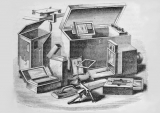
1840
•
people were astonished to find that they could capture a visual image of a moment in time in the minutest detail far surpassing any method that had ever come before
•
the first daguerreotypes were called "the mirror with a memory"
•
photographs in astronomy
•
photographic images of one kind or another constitute almost the sole means of analyzing astronomical objects
•
it therefore behooves us to understand exactly what is involved in obtaining these images, how we perceive them, and what they can tell us
•
earliest photographs of astronomical objects
•
1851: the moon
•
some of the early photos of the 19th century were distinctly eerie
•
street scene taken by Louis Daguerre in 1838 of the Boulevard du Temple
•
a street always teeming with people and horse-drawn carriages
•
yet no one is to be seen except for a tiny figure at the lower left who is getting his shoes shined and was thus motionless for long enough to have his image appear on the photographic plate
•
every other moving object could not register on it
•
thus began a quest still with us today for speed, speed, and more speed so that we can capture progressively shorter and shorter time intervals in our cameras, our telescopes and even out iPhones to be more and more sensitive to light
•
when they do become more sensitive, we can acquire an image in less time and we say we have increased the temporal resolution of observation.
•
today we can capture in 1/10000th of a second what took Daguerre hours to register on his camera
•
we cannot only record the day a photograph is taken
•
but we can time-tag each individual packet of light as they are received into our instruments
•
we call these packets of light photons
•
these photons are the providers of almost all of our astronomical data
•
each photon provides
•
1. time of arrival
•
this allows us to see if the object we are looking at is changing its intensity or light output as a function of time
•
we can search for time variability of cosmic sources
•
2. spatial position that each photon came from
•
how clear the image is
•
in color photographs we have energy information
•
blue light is more energetic than red light
•
x-rays are more energetic than blue light
•
but black and white representations of objects can be more useful than colored ones
•
e.g. you can see which parts are darker than others
•
any representation of an x-ray source is going to be a bit problematical
•
3. energy spectrum
•
the energy of each photon
•
how many photons of each energy gets emitted per second
•
a vital fingerprint for understanding the chemical composition of astronomical objects
•
give insights into the energy producing mechanisms governing their radiation
•
just as florescent lamps work differently than tungsten light bulbs
•
so do cosmic sources have different ways to produce their energy
•
therefore the energy spectrum can tell us what the object is made of and how it produces its light
•
and that's it, all we can glean from tiny pinpoints of light coming from distant light scattered about the universe are these three bits of data encoded into each photon
•
from these data we can construct models to understand the diverse inhabitants of the cosmos