EDWARD'S LECTURE NOTES:
More notes at http://tanguay.info/learntracker
C O U R S E
The Ancient Greeks
Andrew Szegedy-Maszak, Wesleyan University
 |
C O U R S E L E C T U R E Herodotus and The Histories Notes taken on April 28, 2015 by Edward Tanguay |
•
Herodotus (484-425 BC)
•
[hair-ODD-ih-tus]
•
invented the genre of history
•
born in Halicarnassus (today: Bodrum, Turkey)
•
we don't know much about his personal life
•
he comes up in his texts now and then but doesn't tell much about himself
•
tells legends but none very reliable
•
lived among the survivors and witnesses of the war against Persia
•
traveled quite widely
•
has a first-hand acquaintance with Greece, Ionia, and even Egypt
•
intellectual influences that affected him
•
Ionian philosophy
•
identified with a city on the central coast of Ionia: Miletus
•
not to be confused with the Ionian Sea
•
Thales
•
one of the seven sages
•
natural philosopher
•
speculation of the basic substance of the cosmos: air
•
Anaximander (610–546 BC)
•
student of Thales
•
his sudent was Pythagoras
•
basic element was the "immeasurable" the Apeiron [AP-er-on]
•
Anaximenes
•
student of Anaximander
•
basic element was water
•
an attempt to find out what is the basic substance
•
what is missing is the gods
•
rationalists
•
overtly skeptical
•
Xenophanes of Colophon
•
[zen-OFF-en-eez]
•
philosopher, theologian, poet, and social and religious critic
•
lived a life of travel, left Ionia
•
skeptic
•
Gods of Thracians are red haired and blue eyed while the gods of the Ethiopians are snub-nosed and black
•
if cows could depict their gods, they would have horns, hooves, and a tail
•
Hecataeus (550–476 BC)
•
[hek-ah-TEE-us]
•
the first known Greek historian
•
one of the first classical writers to mention the Celtic people
•
wrote: A Trip Around the World
•
actually a trip around the Mediterranean
•
examined customs of different peoples he encountered
•
Herodotus mentioned him but only to criticize him
•
Herodotus was influenced by his prose writing
•
Homer
•
grand sweep of his narratives in the Iliad and the Odyssey
•
provides a model for story telling but Herodotus does something different with it
•
but none of these philosophers had much of a practical impact on the day to day practices of religion or believes in myth
•
The Histories
•
his great work
•
first sentences
•
Herodotus of Halicarnassus here displays his inquiry (histories), which mean "looking into things"
•
not having a muse inspire you
•
conducting your own examination
•
questioning sources
•
so that human achievements may not become forgotten in time
•
histories not only of the Greeks, but foreigners as well
•
very open minded to other cultures
•
sources
•
traveled widely
•
first-hand interviews
•
looking at things
•
Hecataeus
•
Homer
•
underlying tensions of East and West
•
says, "I know who first injured the Greeks"
•
King Croesus (595–547 BC)
•
paradigm of what happens when people get power
•
Herodotus jumps back five generations to tell another story
•
King Candaules
•
had a beautiful wife
•
had a trusted courtier Gyges [GIGH-geez]
•
says that Gyges has to see his wife naked
•
Gyges says it is against all customs
•
tells Gyges to hide and watch her undress
•
Gyges succumbs to this persuasion
•
while Gyges is watching her, she sees him
•
she goes to bed, he slips out
•
next days she summons him
•
you can kill Candaules, marry me, and become king
•
or you can die
•
Gyges chooses the former
•
Herodotus says vengeance would come in the fifth generation after Gyges
•
if there is an injury, there will be some kind of penalty, even if it takes five generations to work out
•
the fifth generation was King Croesus
•
King Croesus [KREE-sus]
•
spectacularly wealthy
•
asks Solon who the happiest man in the world is
•
three have been happier than Croesus
•
Tellus the Athenian
•
had sons
•
his sons had sons who he lived to see
•
died fighting for his country
•
was given the honor of being buried on the battlefield with a monument
•
Kleobis [KLEE-ah-bis] and Biton [BIGH-tawn]
•
painting by Nicolas-Pierre Loir (1624-1679)

•
brothers who died peacefully in their sleep when their mother prayed for their perfect happiness after they had demonstrated filial piety by drawing her to a festival in an oxcart themselves
•
a hero cult was established in their honor
•
a pair of statues was set up for them at Delphi
•
human life changes from second to second
•
"count no man happy until he's dead"
•
this interview with Solon is in the nature of the question "Which man is happy?"
•
Solon is a Greek, a lawgiver, emphasizes quality
•
Croesus is Asian, a monarch, attention is fixed on quantity
•
Croesus' son dies
•
Croesus decides to attack Persia
•
Croesus was fond of the God at Delphi
•
sent lavish gifts to this god of the Greeks
•
asks what will happen if I attack Persia
•
Oracle: you will destroy a great empire
•
neglects to ask whose empire
•
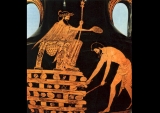
attacks, driven back, captured in palace by Persian king Cyrus [SIGH-rus] (600-530 BC)
•
put on a funeral pyre
•
Cyrus repents to this Barbarism but flames are already too great
•
Croesus prays to Apollo, god at Delphi
•
Apollo sends a rain shower down which quenches the flames
•
Croesus is rescued
•
Croesus and Cyrus establish a kind of rapport
•
Croesus becomes, as Solon had been, a wise adviser
•
Croesus asks Cyrus was are his men doing
•
sacking your city
•
no, they're sacking your city
•
Cyrus admires his wisdom
•
Herodotus sees Croesus as historical pattern that repeats itself: a ruler who
•
has enough
•
wants more
•
commits a rash act
•
suffers consequences
•
Herodotus is intensely interested in the customs of other people