EDWARD'S LECTURE NOTES:
More notes at http://tanguay.info/learntracker
C O U R S E
A History of the World since 1300
Jeremy Adelman, Princeton University
 |
C O U R S E L E C T U R E The End of WWI and the Attempt at Global Peace Notes taken on May 27, 2018 by Edward Tanguay |
•
after WWI ended, the nations were faced with the task of rebuilding the core at the center of the world system
•
tried to patch up the differences they had
•
some envisioned a world that would put an end to the conflicts that had given rise to the First World War
•
an idea put forth as the war ground down: this should be a war to end all wars
•
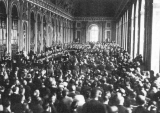
this was the spirit, albeit not well proportioned, of the men who gathered in Versailles in France in 1919
•
imagined and discussed &global& peace
•
Woodrow Wilson was the hero of the day
•
particularly in France
•
treated the entrance of the United States in the war as one of the moments that would rescue France
•
sought to design a new world system
•
shared several principles:
•
1. international trade system had to be restored
•
the change for peace would be better the more there was a global economy
•
restore the gold standard
•
the center of that global economy in the 19th century was London and Britain, using the pound
•
but Britain now had large debts to its dominions and to the United States now
•
it was unclear how this gold standard would get its moorings
•
inhibited by high inflation rates
•
restore trade
•
trade imbalances inhibited this
•
there was no more center to the world economy
•
no plagued by debts
•
this was never completely resolved
•
2. the central powers would be demilitarized
•
3. begin the process of dismantling old empires
•
Woodrow Wilson: inter-imperial rivalry had been the cause of conflict
•
dismantle the empires because empires seek war
•
democratic nation-states are the anchorage for peace
•
self-determined nation-states should be rules by constitutional democracy
•
create protectorates
•
create nation-states out of the old
•
Hapsburg Empire
•
Ottoman Empire
•
colonies were entrusted to become protectorates and mandates
•
Palestine
•
1917 Lord Balfour declared that new states would be created in this zone, and until then these states would become protectorates
•
to govern all of this, there would be a new meta-institution for the world called the League of Nations
•
to prevent future conflicts
•
it was a Utopian architecture
•
met resistance from the United States
•
isolationists believed that the United States
•
the United States Congress refused to ratify the treaty that would give rise to the league of nations
•
this was quite different than the decision by the United States in 1945 at the end of WWII
•
while the League of Nations was approved, the United States was not a member
•
from the beginning, the league of nations was a hobbled organization
•
there arose a spectre of violence and rising racialized genocide
•
WWI was also an internal war among empires
•
Gandhi and others in India became increasingly active again the suppression in India
•
the English economy had become quite dependent on India and needed it to support the war effort
•
the empire was 40% larger than Britain itself
•
1915 Defense of India Act
•
an emergency criminal law enacted by the Governor-General of India with the intention of curtailing the nationalist and revolutionary activities during and in the aftermath of the First World War.
•
especially severe in the Punjab and Bengal
•
by 1918, Britain had over 2 million Indian soldiers in combat and non-combat unions
•
extermination was more sever in the Ottoman Empire
•
mass killing of Armenian Christians
•
Ottomans lived in fear
•
the Dardanelle Straits had been blockaded
•
the Russians had invaded the Ottoman Empire
•
there was concern of non-Turkish people to the Ottoman effort
•
Greeks, Jews, and especially Christian Armenias were targeted for oppression
•
Turkey felt it had to purge itself of foreign elements
•
foreigners inside Turkey was a problem for Turkey itself
•
Yusuf Akçura: "Turkishness is a brotherhood born of race."
•
started concentration camps
•
soon billowed into an extermination campaign
•
goal was to eradicate the Christian presense
•
began in 1915
•
Armenians gathered together in camps
•
something more macabre and sinister
•
how do you tell the story of the hanged and executioners
•
how do you tell the story where the executioners pose for the photographer in front of those they hanged
•
600,000 - 1,000,000 Armenians were slaughtered or died
•
the world had not yet seen a mass killing of non-combatants on this scale before
•
90% of the Armenian population was eliminated
•
WWI was in a sense like a giant onion: conflicts within villages that would escalate outward into large conflicts and eventually a war among empires and brutality between states
•
so a war of this constitution and magnitude was not a war to end all wars
•
in some ways, we are still trying to cope with its aftermath