EDWARD'S LECTURE NOTES:
More notes at http://tanguay.info/learntracker
C O U R S E
Alexander the Great
Guy MacLean Rogers, Wellesley College
 |
C O U R S E L E C T U R E Battle of Chaeronea (338 BC) Notes taken on October 1, 2015 by Edward Tanguay |
•
during large, set-piece battles that Alexander fought
•
companion cavalry usually stationed on right-hand side
•
on the left-hand side, the Cavalry of Thessaly
•
1800 man strong unit
•
commanded by a Macedonian officer
•
fought in a diamond or rhomboid shape
•
a defensive shape
•
allowed to fight in any direction
•
Battle of Gugamela
•
though heavily outnumbered, Alexander emerged victorious due to his superior tactics and army
•
defensive fighting allowed Alexander to launch a wedge attack against left side of Persian lines
•
Cavalry of Thessaly equal to that of Macedon
•
big picture
•
what Philip did was to create the first truly professional army in world history
•
in fact, what he did was turn a state into an army
•
an army trained to fight in any tactical situation
•
under any circumstances
•
on any terrain
•
throughout the year
•
this was not an army of amateur citizen soldiers as in Greece
•
this was an army of professionals whose sole profession was warfare
•
during the 350s and 340s first the Phocians, then the Thessalonians
•
until he came into contact and conflict of that second ring of Macedon's enemies, the city-states of central Greece
•
Third Sacred War (356–346 BC)
•
fought between the forces of the Delphic Amphictyonic League, principally represented by Thebes, and latterly by Philip II of Macedon, and the Phocians
•
caused by a large fine imposed in 357 BC on the Phocians by the Amphictyonic League (dominated at that moment by Thebes), for the offense of cultivating sacred land, refusing to pay, the Phocians instead seized the Temple of Apollo in Delphi
•
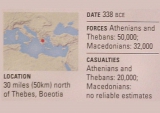
338 BC: Battle of Chaeronea [Χαιρώνεια]
•
matters came to a head at the
•
between the Macedonians led by Philip II of Macedon and an alliance of some of the Greek city-states including Athens and Thebes
•
battle was the culmination of Philip's campaign in Greece (339–338 BC) and resulted in a decisive victory for the Macedonians
•
Philip had the more professional army
•
Philip's 18 year old son, Alexander, led the decisive charge through the line of the city-states
•
1000 Athenians were killed
•
entire sacred band of Thebes wiped out
•
the outcome changed the course of history for Greece and the Mediterranean world
•
the Athenians received back their 2000 prisoners of war
•
but were forced into an alliance with the Macedonians
•
Thebes lost control of the rich, agricultural plain around the city and an oligarchic government was imposed upon it
•
Sparta, which had taken no part in the battle, had its territory invaded
•
Macedonian garrisons were installed at Corinth, Thebes, and elsewhere
•
Macedon's domination of Greece was no longer a matter of diplomacy and soft power, but a fact of arms