EDWARD'S LECTURE NOTES:
More notes at http://tanguay.info/learntracker
C O U R S E
Sexing the Canvas: Art and Gender
Jeanette Hoorn, The University of Melbourne
 |
C O U R S E L E C T U R E Cezanne’s Bather: Masculinity and Movement Notes taken on July 21, 2018 by Edward Tanguay |
•
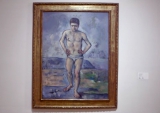
Paul Cezanne's The Bather (1885)
•
one of Cezanne's most arresting paintings
•
subtle tones of grey, blue and green
•
one of the hundreds of paintings Cezanne made around the subject of bathers and bathing
•
painted bathers throughout his career
•
more than 30 years
•
many have written on his remarkable obsession with the theme
•
the eroticism of Cezanne's bathers
•
his at times seemingly out-of-control brush work has been interpreted as conveying a sort sexual frisson
•
frisson, n. a sudden strong feeling of excitement or fear, a thrill
•
rendition of fleshy and nubile bodies in which men and women cavort together in a range of settings are at odds with The Bather
•
a solitary figure of a young man in an open landscape
•
pure, tentative, uncertain, absorbed in his experience
•
as he finds his footing through a rocky coastal terrain
•
sparse and uneven
•
the body of the young man is positioned solidly, though very lightly
•
the grey hues with green highlights create the feeling of a coastal location
•
Cezanne famously spent lengthy periods of time in nature on his own
•
enjoyed bathing in the outdoors from his youth in Paris
•
where he studied with Émile Zola
•
particular feature of this painting that separates it out
•
figure in the picture is based on and present in a particular photograph
•
the shape of the body
•
the averted gaze of the subject
•
the way the figure distributes his weight mid-step
•
the placement of his hands on his hips
•
the folds in the drapery
•
even the over-sized nipple
•
why did he use a photograph
•
an experiment
•
following a program
•
his slavish adherence to the features of the photograph
•
has something of the scientific study about it
•
removed from the studies of erotic sensation and of the sensual body
•
rather the body in nature
•
1872 Darwin: The Expression of the Emotions in Man and Animals
•
used photographs to illustrate facial expression of emotions
•
Antoine Fortuné Marion
•
professor and director of the Natural History Museum in Marseille
•
painter and paleontologist
•
became one of France's leading Darwinists
•
researched the fossils of the Montagne Sainte-Victoire region
•
Cezanne also used a photograph to study the human form
•
the combination of the subjective emotions of the bather with the landscape
•
bathers hands are exaggerated
•
rhyme visually with the bather's feet
•
the feet also having grown in size
•
a work that is more about the body than bathing
•
presents a scientific study of a stationary body
•
complements movement forward but has yet to enact that process
•
Eadweard Muybridge (1830-1904)
•
English photographer important for his pioneering work in photographic studies of motion
•
published in 1887 at the University of Pennsylvania
•
Etienne-Jules Marey (1830-1904)
•
a French scientist, physiologist and chronophotographer
•
lived in Paris
•
in this way, The Bather stands apart from the many other works that Cezanne drew of bathers
•
is more like the scientific studies of the human body in motion at the time
•
the primary task Cezanne asks of the viewer
•
to ask how the young man takes a step forward into a rock pool
•
it is the precise study of movement
•
the articulation of the placement of the weight of the human body in anticipation of stepping forward
•
not the sensual pleasure that we associate with Cezanne's pictures of bathing bathers
•
which has received most of attention of art historians