EDWARD'S LECTURE NOTES:
More notes at http://tanguay.info/learntracker
C O U R S E
Alexander the Great
Guy MacLean Rogers, Wellesley College
 |
C O U R S E L E C T U R E Alexander's Cavalry Units Notes taken on August 27, 2015 by Edward Tanguay |
•
raising horses
•
central Greece
•
the land and resources of not particularly suited to rearing horses, which require:
•
fields
•
fodder
•
water
•
people who could spend high amounts of time tending to them
•
none of these are in abundance
•
lower Macedon
•
broad fields
•
much food
•
much water
•
large group of Macedonian nobles were willing to spend their resources on breeding and raising a large number of resources
•
just as Philip, introduced their sons to horses and riding from a very young age
•
put into one of the units of the cavalry
•
two squadrons
•
recruited locally
•
200-250 riders in each squadron
•
royal squadron
•
fought around the king when he fought in battle
•
a kind of an extended body guard of the king
•
the best riders in all the kingdom of Macedon
•
most riders were probably excellent horsemen
•
horses
•
smaller on average
•
did not have saddles or stirrups
•
had to control their mounts with used:
•
harsh bridles and bits
•
pressure with legs
•
had to
•
ride galloping at 35 miles per hour
•
stay in formation
•
held reins of horse with one hand
•
weapon in the other hand
•
all the while dodging javelins and arrows
•
primary weapon
•
tapered, three-meter-long lance
•
blades at both ends, just in case your lance broke
•
you would still have part of a weapon with a sharp edge to it
•
you could throw the lance
•
or thrust with it overhand or underhand
•
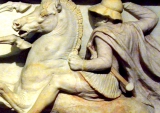
in famous Alexander mosaic, he is thrusting with one of those lances
•
also reserve weapons
•
javelins
•
very likely the majority wore metal helmets and breastplates
•
difference between cavalry of Greek city-states and Macedon
•
Greek city-states
•
provided cover for
•
flanks
•
retreating infantry men
•
Macedon
•
to envelop their foes
•
to punch holes through the lines of their enemies
•
an offensive strike force design to open up gaps in enemy lines
•
attacked enemy lines on a wedge formation that focused speed, mass, and force on a single point
•
the wedge was formed in the shape of the Greek letter "Δ", or Delta
•
in doing so, that distinguished their doctrine of attack from other cavalry contingents which usually attacked on a broad front
•
thereby diffusing the amount of power and momentum that they brought to the battle field
•
the leaders of each wedge fought at the front
•
the cavalry men followed him like cranes following a lead crane in flight
•
when the leader turned left or right, they simple followed him
•
it was Philip apparently who introduced this wedge formation into the Macedonian cavalry playbook
•
in each of the major battles that Alexander fought that ended up that ended up overturning the Persian empire, he fought at the front of one of those wedges