EDWARD'S LECTURE NOTES:
More notes at http://tanguay.info/learntracker
C O U R S E
Sexing the Canvas: Art and Gender
Jeanette Hoorn, The University of Melbourne
 |
C O U R S E L E C T U R E Seduction in Boucher's pastoral paintings Notes taken on February 12, 2017 by Edward Tanguay |
•
Boucher's pastoral paintings
•
a pendant pair
•
two works that were created to be displayed together
•
hung on either side of a medallion portrait by John Baptist Lemuel of Louis XV
•
both the paintings and the medallion sculpture are from 1748
•
the height of King Louis XV's time as king
•
the epitomize aspects of 18th century French art
•
defined by its lightness of touch, sense of beauty, its eroticism and connections with themes of love
•
Louis XV was known as Louis XV The Well Loved
•
not just by his people but by women
•
Madame de Pompadour
•
he had several mistresses, she was the favorite
•
single most important female patron of the arts in France
•
her favorite painter was Francois Boucher
•
first painter of the king
•
director of the academy of French Painting and Sculpture
•
group of artists
•
during the time of Louis XIV came together to establish the rules of painting and sculpture and how artists should be trained
•
Boucher plays with conventions
•
a part of Rococo art
•
relied on skilled users
•
had learned how to decode painting in connection with their ideals of sociability and behavior
•
pastoral paintings
•
finished in 1748
•
closely connected to pastoral literature and plays
•
plays in the 18th century did not only take play in official theaters
•
also in private theaters of the nobility
•
worked with Favart
•
reformed the comic opera
•
took the bawdy and ribald performances of sexuality in pantomime, and connected them with refined codes of sociability that appealed to the nobility
•
with the idea that the more refined audiences would start coming back to the theater
•
Favare and Boucher grew up near each other
•
by the 1740s they were collaborating
•
Boucher came up with the ideas which he painted which then Favart then turned into plays and performances
•
Boucher also did costume design and scenic backdrops for pastoral plays
•
many plays derived from a tradition of pastoral literature that goes back to the 17th century
•
a salon culture dominated by women and the tastes of women going back to Louis XIV
•
by Louis XV, women set many of the standards of taste
•
visual arts
•
literature
•
performances
•
in the discourse of refined behavior
•
pastoral plays
•
no dialogue
•
familiar songs in the background telling what people were doing
•
set in a golden age somewhere in a landscape
•
usually a simple love story between a shepherdess and a shepherd
•
gives her a flute lesson
•
girl asleep, young man who delivers a basket of flowers from the shepherd
•
Favart's wife was often the main lead
•
but not always as the shepherdess but the shepherd
•
quite different from many other eras
•
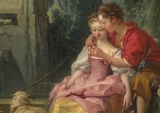
Portrait: Leçon de flute
•
these are not real shepherds and shepherdesses that work in the fields
•
but idealized
•
wander around the landscape with their sheep and think about nothing but love
•
the sheep are always perfectly coiffed
•
the shepherdess is not engaged with her sheep
•
she is learning a lesson from her shepherd who is attempting to woo her
•
next to them a fountain of love
•
connection with aristocratic way of life
•
the nobility defined themselves by not working
•
by the mid 18th century, they also had no real military function anymore
•
they spent a large amount of their time pursuing leisure which was their primary occupation
•
one aspect of that leisure was the pursuit of love
•
a highly codified way of wooing a woman
•
the crudeness of sexuality is turned into something that is highly refined and coded
•
at the foot of the woman is a crown of flowers
•
one meaning is that she gives this to her lover when he wins her heart
•
also an erotic meaning of the vagina
•
the flute
•
a reference to the male penis
•
her being taught to play it is a reference to her being taught to perform oral sex
•
not understood by everyone but only those in a small elite circle
•
Boucher's conventions on gender
•
male figure is seated above the female figure
•
Mannlich, student of Boucher
•
had students make many drawings which Boucher signed and sold them off
•
Boucher corrected the way students were painting the female body
•
the female body should be painted as if it had hardly any bones at all
•
the idea is that they're curved, soft lines
•
nothing that's hard or breaks the eye in a way as it moves around the canvas
•
female has a porcelain white color
•
male figure has more of a sun-kissed look, more flesh tones
•
The Mysterious Basket (1748)
•
female and male are different along the customary markings
•
the man is not the shepherd but the rustic delivering the basket
•
man is very masculine
•
ripples and veins
•
fleshy and physicality that we don't see with the shepherd
•
he is crude character
•
Boucher was often criticized when pastoral scenes were shown in salons
•
the way these coded meanings were understood, was a kind of pastoral versions of themselves, i.e. the upper echelons of society
•
when they were shown at general salons they were criticized and seen as dangerous
•
where art exhibitions take place every two years in Paris
•
the perfumes of the fish mongers wife mixed with the perfumes with the ladies of the court
•
showing sexuality as having any consequences
•
you can learn to play a flute, but there is no suggestion that that can lead to any sort of moral downfall
•
the male didn't look masculine enough
•
less friendly critics
•
Denis Diderot
•
founding member of the encyclopedia
•
didn't like Boucher's work
•
thought it was moral degenerate
•
in a later salon, Diderot, says, "when am I going to be rid of these pastorals"
•
women would come and linger in front of these painters and would not understand that there was a price to be paid for this kind of sexual activity
•
it was a misinterpretation of signs and symbols meant for certain class of society