EDWARD'S LECTURE NOTES:
More notes at http://tanguay.info/learntracker
C O U R S E
The Modern World: Global History since 1760
Prof. Philip Zelikow, University of Virginia
 |
C O U R S E L E C T U R E Post World War I: The Age of Uncertainty Notes taken on August 29, 2013 by Edward Tanguay |
•
after WWI the common sentiment was that Europe was a broken world
•
the certainties of the past seemed gone
•
human losses:
•
9-10 million people killed
•
10s of millions people damaged in some way, physically or psychologically
•
conditions of war helped produce the worst outbreak of disease, the Great Influenza Epidemic of 1918
•
90% of the people killed were soldiers, so this was not a war like WWII where the majority of the people killed were not soldiers
•
marked the demographics of Britain, France, Russia and smaller countries such as Serbia and Bulgaria
•
loss of the Old Order
•
the gentile society of gentleman and ladies was gone
•
the Edwardian era, the Victorian era
•
a loss of confidence
•
Before World War I, there was a general sense that the world was driving forward into newer and higher things. After WWI, there was a general sense that the world was driving forward into newer things, but that they weren't necessarily higher.
•
loss of confidence that people know they were sure what was right in politics and religion
•
loss of faith in rationality itself
•
the results of the war seemed so crazily disproportionate to anyone's open purposes that it caused people to doubt even reason and rationality itself
•
arise of Critical Theory: beneath the veneer of what we say at a rational level, we're hiding our deeper subjective constructs of the way we want the world to be that we express in our vocabulary of rationality
•
the study of the subconscious
•
Sigmund Freud and Carl Jung
•
attention to subconscious motives and drives
•
Walter Gropius (1883-1969)
•
architecture became unadorned, no frivolities, straight lines
•
functional, natural, rational, building has a purpose without all the veneer on top
•
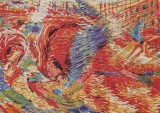
futurism art movement
•
early 19th century Futurism expressed a passionate loathing of everything old, especially political and artistic tradition
•
Italy mainly
•
the celebration of dynamism
•
Umberto Boccioni (1882-1916)
•
sculpture: Unique Forms of Continuity in Space, 1913
•
"pure, driving motion and muscle power itself, the essence of it"
•
joined the Italian army, killed in training accident in 1916
•
wanted the nation to express the force shown by dynamism, supporters of Italy's entry into WWI
•
relationship between futurism and fascism
•
don't think of Fascism as a reactionary doctrine: they felt they were very modern
•
a struggle of man
•
Mussolini:
•
Fascism is opposed to classical Liberalism, which arose from the necessity of reacting against absolutism
•
the state recreates the nation in its desired image through the will of the people identifying with the state
•
"Liberalism denied the State in the interests of the particular individual; Fascism reaffirms the state as the true reality of the individual, therefore, for the Fascist, everything is in the State, and nothing human or spiritual exists, much less has value, outside the State."
•
Gerardo Dottori (1884-1977)
•
The Duce, 1933 ##dottori
•
"Italy's leader, the symbol of national force"
•
global America
•
"the symbol of materialism that Mussolini so detested"
•
it's not because America had become the supreme military power in the world
•
the real influence from America economy, American finance, and American culture, the rise of consumerism, of mass-market advertising, of seducing people to buy a lot of things whether they need them or not, America represented above all an abundance of household goods, of the material well-being of ordinary people supplied through a free market, mundane things such as a way to improve your sewing machine, or if your home is too hot in the summertime, Sears is helping you buy larger electric fans, even a kind that will oscillate, or if your home is too cold in the window, a new room heater with more features than the old room heater.
•
cars, highways, gas stations, drive-in movie theaters, America was the premier producing of affordable automobiles
•
broadcast radio
•
for the first time in human history, you could sit down at night and listen to people talking to you from thousands of miles away
•
movies
•
Hollywood becomes a premier producer of movies which were consumed globally