EDWARD'S LECTURE NOTES:
More notes at http://tanguay.info/learntracker
C O U R S E
A Brief History of Humankind
Dr. Yuval Noah Harari, The Hebrew University of Jerusalem
 |
C O U R S E L E C T U R E The Future of Cyborgs and Robots Notes taken on August 3, 2014 by Edward Tanguay |
•
cyborg engineering
•
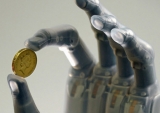
combining organic and inorganic parts such as a human with bionic hands
•
in a sense all of us are cyborgs today since our natural senses and functions are supplemented and improved by eyeglasses, pace-makers, synthetic teeth, plastic hips, or metal screws in our joints
•
however, in the future, this process is likely to go much further
•
we are likely to have inorganic devices connected directly to our brains and our nervous systems, devices that will become inseparable from us and that will change our abilities, desires, personalities and identities
•
the bionic ear
•
over 300,000 people already have bionic ears (cochlear implants) [KOK-lee-er]
•
can identify human voices and other important sounds
•
this cannot only help deaf people acquire basic hearing, it can enable people with normal hearing to acquire new hearing abilities
•
bionic arms
•
Jesse Sullivan
•
lost both arms in electrical accident
•
Claudia Mitchell
•
lost her arm in a motorcycle accident
•
both of them now use bionic arms
•
these arms are operated by thoughts alone
•
bionic arms are currently a poor replacement for the original, but they have the potential for unlimited technological advancement
•
in the future bionic arms and hands will can made much more powerful than our human arms and hands
•
bionic arms have the advantage that they can be replaced and/or upgraded
•
they can also be detached from the body and operated at a distance
•
we are used to our limbs being attached to our body, but this will change
•
there is no reason why our future limbs will need to be in the same room as our bodies
•
in experiments with rhesus monkeys, electrodes were attached to their brain
•
they were trained to control detached arms
•
2008 experiment: Monkey in North Carolina controlled robot legs in Japan over the Internet
•
locked-in syndrome
•
patients lose ability to move bodies
•
yet cognitive abilities remain intact
•
they communicate with eye movements
•
current experiments are attempting to translate brain signals of these patients into meaning
•
there are scientific projects currently running to create a two-way brain/computer interface
•
will allow computers to read electrical signals of human brain
•
potential inter-brain communication
•
engineering completely non-organic beings
•
while cyborgs combine organic parts with inorganic parts, robots and software are completely non-organic
•
software is being created that evolves independently of the creator of the program
•
computer virus
•
as it spreads, it replicates millions of time
•
it is chased by predatory, anti-virus programs which try to destroy it
•
a human could program a virus to make occasional random replication mistakes
•
this kind of virus would be more difficult to identify by antivirus software
•
this will lead to cyberspace containing viruses which no human being engineered, viruses which undergo non-organic evolution
•
are non-organic, evolving viruses life?
•
it depends how you define life, but this is a new pathway for evolution to create new phenomena in our real world which affect us and which we can predict only with difficulty, and which is completely independent of the organic world and its limitations
•
2005 Blue Brain Project
•
goal is to recreate a brain inside a computer
•
April 2013 European Union decided to make the Blue Brain Project the flagship project for the next decade by giving it one billion euros in funding