EDWARD'S LECTURE NOTES:
More notes at http://tanguay.info/learntracker
C O U R S E
Exploring Beethoven's Piano Sonatas
Jonathan Biss, Curtis Institute of Music
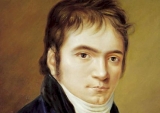 |
C O U R S E L E C T U R E Beethoven: The First Professional Composer Notes taken on October 10, 2013 by Edward Tanguay |
•
Beethoven was the first composer who had models to follow
•
although he may have dislike some of his employers, musically, at least, he had all the tools to thrive within the system
•
notably bad at taking orders
•
would have made a terrible court composer
•
was able to make decisions about his music in a way that Haydn and Mozart never could, particularly in their youth
•
he composed at an unbelievable pace
•
600 works in a 30 year period
•
including 22 operas and 41 symphonies
•
rarely sacrificed quality
•
Beethoven revised his music more extensively than Mozart did
•
came to Vienna for a prescribed period of sponsored study
•
most people would have, when finished, returned to Bonn
•
Beethoven knew that Vienna was the place he had to be if he wanted to have independence in writing his works
•
he did have patrons
•
Joseph Franz Maximilian Lobkowicz (1772-18116)
•
one of Haydn's and Beethoven's patrons, dedicatee of some of these composers' greatest works, including Haydn's "Lobkowitz" quartets (Op. 77), and Beethoven's 3rd, 5th, and 6th symphonies and his Op. 18 string quartets
•
Moritz Lichnowsky (1771–1837)
•
faithful friend of Ludwig van Beethoven
•
but as you can see from their correspondence, they were more friends, not employers
•
few expectations placed on Beethoven
•
sponsored him out of belief in his talent
•
this allowed Beethoven to publish at a less frenzied rate, first works at 25
•
very late compared to Haydn and Mozart
•
at 25, Mozart had already written half of his published works
•
when Beethoven finally published Opus 1 (three piano trios) it earned him enough money to live for a year
•
for the most part, was not reliant on patrons during his lifetime
•
after 1811, the last 16 years of his life, did not perform publicly at all
•
received commissions from as far away as England, the 9th symphony, but never went to England (unlike Haydn)
•
received commissions from Russia for three of his last quartets
•
he really was the first professional composer
•
the meanings of the sonatas as opposed to the quartets and symphonies
•
only one of his sonatas was performed publicly in Beethoven's lifetime (Opus 101, Sonata No. 28, late work, forward-looking, difficult to comprehend)
•
the piano recital didn't even exist until Liszt started playing them in the 1830s ("Le concert, c'est moi")
•
in Beethoven's day, one did not go to concerts to hear new piano works
•
therefore, the sonatas and quartets were home music and not concert music, which gave them their special character for three main reasons:
•
1. Beethoven didn't have to think about the limitations of players, inadequate rehearsal time, inadequate conditions
•
his reputation would not be jeopardized by home musicians struggling through the sonatas the way it would if his symphonies were massacred in performance
•
the removal of this impediment meant that Beethoven's imagination could be fully engaged in a way that it couldn't with the symphonic music
•
2. audience comprehension was also a much lower concern, since the music was to be played at home, it became a kind of private experimentation between Beethoven and the player
•
it cannot be a coincidence that as revolutionary as the Ninth Symphony is, the last sonatas and the quartets, written contemporaneously with the Ninth Symphony, are far more ahead of their time
•
3. there is an inherent difference in playing alone and playing in a large group, sonatas already have a degree of intimacy greater than symphonies, and when it is a solo sonata, there is a almost religious sense with communing privately with music.