EDWARD'S LECTURE NOTES:
More notes at http://tanguay.info/learntracker
C O U R S E
A History of the World since 1300
Jeremy Adelman, Princeton University
 |
C O U R S E L E C T U R E 16th Century Colonialism Fueling European Violence Notes taken on November 3, 2013 by Edward Tanguay |
•
for all of the European bullying in the Indian Ocean, they had to adapt to existing institutions
•
gaining access to the supply of goods that they wanted was very complicated
•
in the rivalry between the European powers, local traders could use this to their advantage and play them against each other
•
local traders were making money in this business as well
•
pepper prices were very high at this time
•
Arab traders realized that they could manipulate the Europeans by flooding the market, making prices go up and down
•
Dutch had to spend more money on defenses while their businesses were beginning to yield losses
•
Europeans went after choke points in the Indian Ocean usually run by Sultanate families conducting and managing trade but did not have the defense systems set up as did the Chinese
•
China wasn't vulnerable in this way because they were an agrarian dynasty instead of a dynasty reliant on Arab trade
•
China relied more on taxes skimmed off of agricultural producers instead of rent from merchants
•
hence the Europeans went after those more vulnerable polities reliant on trade
•
alliances were formed between strong Sultanate families and European powers
•
so there was a different model of empire for Europeans in East Asia than in the Americas
•
the Dutch created the Spice Islands as colonies but otherwise what Europeans tended to do in East Asia was to control the trade systems from the peripheries of the Asian dynasties
•
for the most part, the Europeans were not creating power kingdoms and colonies as they were doing in the Americas
•
aside from capturing and showing their mercantile muscle in the most vulnerable choke points and entrepôts such as Macao, Hormuz, Bengal, and Calicut, the Europeans barely touching down on the surfaces of East Asian trade systems
•
and for all of the bullying, the Portuguese were soon forced to roll back, the Mughals drove them out of Bengal in 1632
•
Japan did the same to all the missionaries and traders who arrived in Japan in 1637
•
so by the late 17th century, the Europeans had a few points of minor control in East Asia which was in contrast to the vast colonies they were controlling in the Americas
•
East India resembled more the trading points of Africa than they did the American colonies
•
nevertheless, the European influence in East Asia was the beginnings of the reordering of the region
•
and the reordering of East Asia wound up augmenting a disequilibrium within Europe itself
•
the wealth that poured in from the rest of the world had a mixed blessing for many of the states, particularly for the Spanish since Spain was now under attack all over: abroad and in Europe, and compelled to defend a model of religious tradition and devotion against heretics in the form of the reformation from 1520 on, there are simmering disputes in Germany spreading to Holland, then part of the Spanish empire, and to England and elsewhere.
•
1520 Reformation
•
Martin Luther publishes on the freedom of Christian man
•
gives rise to a century of religious wars of denominational cultures within Europe
•
overlaps with and intensifies the rivalries between the dynasties of Europe
•
new world silver, drawn out of Andean mines, was used to fuel these religious wars
•
silver funded the Reformation and Counter-Reformation struggles
•
1534 Jesuits founded to defend piety
•
war in Holland because Spain's Vietnam
•
each side of the political struggle in Europe depended on a system of predation and exploitation the rest of the world
•
they needed to harass resources to wage the war at home
•
so the globalization of European power fueled the violence within Europe itself
•
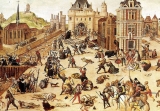
1572: St. Bartholomew's Day massacre
•
1618-1648: Thirty Years War
•
Treaty of Westphalia
•
change in diplomacy in Europe
•
put end to major conflicts
•
left Spain heavily indebted, a world power dependent ever more on its colonies to sustain itself
•
rise of Holland, France, England
•
an end to the dream that Europe might be governed by a new Roman Empire, able to go liberate the Holy land, a fantasy of the political leaders in Europe for centuries