EDWARD'S LECTURE NOTES:
More notes at http://tanguay.info/learntracker
C O U R S E
Western Music History through Performance
Jonathan Coopersmith, Curtis Institute of Music
 |
C O U R S E L E C T U R E Ars Nova, New Rhythm in the 14th Century Notes taken on January 20, 2016 by Edward Tanguay |
•
at the beginning of the 14th century
•
there was finally a system of musical notation which
•
showed exact pitches
•
but durations were relative
•
music before this had been rhythmically grouped always into threes
•
same note shape could be given two or three beats, but depending on context
•
confusing
•
limiting
•
Philippe de Vitry
•
credited with creating the ars nova
•
Latin for "new art"
•
the last line of his treatise is "This is the new art."
•
ars nova is a name for the era of music in the 1300s
•
innovations in notation
•
breaking with the idea of a "perfection", i.e. that music needed to be grouped into threes
•
allowed for several levels of division
•
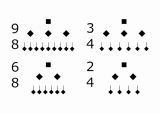
breves could be broken into groups of two or three semibreves
•
semibreves could be broken up into 2 or 3 smaller units called minims
•
a radical shift
•
for the first time, note durations were fixed
•
and no longer confined to groups of three
•
definitions
•
breve = double whole note
•
semibreve = whole note
•
four distinct time signatures or meters
•
9/8 time signature
•
breve into 3 semibreves into 9 minims
•
this is like three groups of triplets which wasn't such a big change from what had come before
•
if a breve is divided into three semibreves, as before, but each breve is divided into only two minims
•
a new feature of ars nova
•
3/4 signature
•
if a breve is divided into only two semibreves, and each breve into three minim
•
this gives us a 6/8 signature
•
sounds like two groups of triplets
•
not a big change
•
but if a breve is divided into only two semibreves, and each breve into only two minims
•
this gives us a 2/4 signature
•
a completely new sound
•
the most radical of all new time signatures since there were no groups of three at all
•
the real innovation is fixed note shapes
•
notes were no longer relative
•
both triple and duple meter (2/4) are possible
•
syncopation is possible for the first time
•
the shift of a musical accent in which emphasis is given to weak beats instead of strong beats
•
since note shapes retain their rhythmic value regardless of the context
•
allowed composers to exploit combinations of rhythm
•
some of the most complex music was composed during this time
•
combining syncopations, mixed meters, and different voices and meters at the same time
•
without this new notation, the innovations that occurred in the Renaissance would not have been possible