EDWARD'S LECTURE NOTES:
More notes at http://tanguay.info/learntracker
C O U R S E
Western Civilization: Ancient and Medieval Europe
Ian Moulton, Arizona State University
 |
C O U R S E L E C T U R E Ancient Egyptian War, Politics and Gods Notes taken on April 27, 2016 by Edward Tanguay |
•
the Narmer Palette (31st century BC)
•
one of the oldest and most important artifacts from Ancient Egypt
•
thought by some to depict the unification of Upper and Lower Egypt under the king Narmer, which is the founding of the unified Egyptian kingdom under one pharaoh
•
a stone palette
•
on the pallete, Narmer is wearing the crown of Upper Egypt about to hit a prisoner with a club
•
demonstrates the power of the pharaoh based on force
•
Narmer is larger than anyone else in the depiction
•
on the back side
•
Narmer is wearing the crown of lower Egypt
•
in a procession
•
again, the pharaoh is larger than the other people in the depiction
•
Statue of Ramses II at Luxor
•
a New Kingdom pharaoh
•
whereas Narmer was an Old Kingdom pharaoh
•
Ramses II (1279-1213 BCE)
•
over a thousand years after Pharaoh Narmer
•
led an enormous building campaign
•
many temples and statues of himself across Egypt
•
half of the surviving temples in Egypt date from the time of Ramses
•
apparently had many dozens of children
•
a pharaoh was a kind of super-human, father-god figure
•
statues are much larger than life-size
•
represented in similar ways to Narmer
•
wearing a crown which symbolizes upper and lower Egypt joined
•
has beard which represents his status as pharaoh
•
pharaohs are often represented still, often seated, which suggests repose and tranquility
•
suggested that they don't need to move, that they are so powerful they can just sit
•
led many military campaigns
•
south against the Nubians into modern-day Sudan
•
north against Hittites into modern-day Syria
•
we aren't sure how well he did in these battles
•
the representations of them are all apparently commissioned by Ramses or other Egyptians to suggest what a great leader he was
•
clearly he did a good enough job to keep Egypt from being invaded by either the Nubians or the Hittites
•
it may be that he just fought them to a standstill and everyone went home
•
a few cases where Pharaohs are represented differently
•
Queen Hatshepsut (1507–1458 BC)
•
a member of the Egyptian royal family
•
the daughter of Thutmose I
•
the wife of his son Thutmose II, so she married her brother
•
mother of Tutmose III
•
the way the family structure of the dynasty was set up was that it was based on inbreeding within the family and incest
•
the belief that the pharaoh's family was so sacred that members could only marry members of that family
•
this makes good symbolic sense but very bad genetic sense
•
resulted in many difficulties for the pharaohs over time
•
Tutmose III became pharaoh at the age of one
•
she was made the regent to rule over the kingdom
•
instead of simply be the queen mother who was in charge until her son grew up
•
she actually took over as pharaoh
•
this was something that was not usually done in Ancient Egypt by women in the royal household
•
some statues of her represent her as a women, but other shoe her as a pharaoh where she is represented as being male
•
she was probably seen as taking on masculine identity
•
she becomes symbolically the father of the country
•
the Temple of Hatshepsut
•
survives to this day
•
one of the best surviving temples from that period
•
clearly she wasn't any kind of second-class pharaoh of that period
•
Bust of Nefertiti
•
the wife of Pharaoh Nakanatan
•
her bust was sculpted in 1345 BCE
•
one of the most stunning works of art from ancient Egypt
•
Neues Museum in Berlin
•
the Egyptians want it back
•
the Germans want to keep it
•
painted on limestone
•
realistic and life-like
•
details
•
wrinkled on her eyelids and neck
•
represented as a human woman not a god
•
wife of Akhenaten
•
the most unique and distinctive pharaoh of all
•
tried to completely transform Egyptian religion
•
the only real god as the sun-god Aten
•
made Aten into part of his name
•
Egyptians followed this for a little while
•
this fell apart pretty quickly after he died
•
one of the first cases of anywhere in the world of monotheism
•
most societies were polytheistic
•
before the Jewish religion and certainly before Christianity or Islam
•
had unorthodox religious beliefs but also allowed unorthodox styles of art
•
Bust of Nefertiti
•
much more realistic than other pharaonic art before and after Akhenaten
•
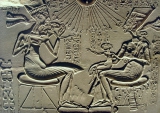
art work: Akhenaten, Nefertiti, and their Children
•
an ordinary family
•
a kind of an emotional, laid-back picture with a certain sentimentality about it
•
much more informal representation in Egyptian history
•
Tutankhamen
•
Akhenaten's son
•
Nefertiti was not his mother since Akhenaten had many wives
•
we don't know who Tutankhamen's mother was
•
but Tutankhamen's mother was one of Akhenaten's sisters
•
came to throne of age 9
•
lived to age 19
•
death was probably caused by broken leg
•
probably also had malaria
•
throughout his life also had trouble walking because he had birth defects being from an incestuous union in a family that had been incestuous before that
•
not known for anything he did as pharaoh
•
is known because his tomb was the only one found in the modern age without anything having been taken from it
•
his tomb was opened in 1923 by Howard Carter
•
they found all of the regalia, all of the tomb artifacts, and all of the gold and jewels and treasures
•
this find is important because Tutankhamen didn't rule for very long