EDWARD'S LECTURE NOTES:
More notes at http://tanguay.info/learntracker
C O U R S E
Greeks at War: Homer at Troy
Robert Garland, Colgate University
 |
C O U R S E L E C T U R E Homer, the Heroic Code, and the Wastage of War Notes taken on August 16, 2015 by Edward Tanguay |
•
takes place as a series of individual encounters, not has a continuous narrative
•
monotonous for some modern readers
•
two warriors engage, one is hit, his limbs collapse, darkness descends, and then we're on to the next engagement
•
only once do we get a sense of the sweep of the battlefield
•
when Zeus holds up his golden scales to determine which side should prevail
•
the Trojan War comes across to us cumulatively
•
we see hundreds of vignettes of soldiers getting killed
•
yet it's as if we see a heap of corpses piling up as the poem continues
•
much seems artificial to modern readers
•
Aeneas, before engaging in fight with Achilles, delivers a 50-line speech about his genealogy
•
but this doesn't diminish what is highly realistic
•
the gods take sides and influence the course of action
•
deeply and personally committed to the outcome
•
Hera hates Troy because the Trojan prince Paris denied her the prize in the divine beauty contest between her, Athena, and Aphrodite
•
he awarded it to Aphrodite who bribed him with the promise of the most beautiful woman in the world, Helen
•
Greek and Trojans all believe in the same gods
•
the principle shrine in Troy is a sanctuary of Athena
•
one might think that this would make the action less real
•
but the gods don't constantly intervene
•
many of their interventions are irrelevant or unnecessary
•
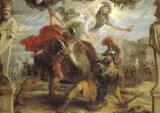
Hector and Achilles are fighting
•
climactic episode in poem
•
Athena disguises herself as a comrade of Hector to deceive him in the belief that he can win against Achilles
•
a way of saying that Hector was not thinking realistically about the situation
•
has psychological plausibility
•
Book 8: Zeus brings up his scales to see who will prevail that day
•
but he's not actually influencing the outcome of the battle
•
it doesn't indicate the Zeus is running the show
•
it is used to indicate that Achilles absence from the battle field is turning the tide
•
for some readers, the presence of the gods in the Iliad adds a layer of unreality
•
there are moments when the gods appear to be pulling the strings
•
Hera comes onto Zeus and makes love to him hidden within a golden cloud on the summit of Mount Ida
•
Zeus goes into a post-coital slumber and the battle goes in the favor the Greeks
•
but this is just Homer having a bit of fun, and is expressing a sense of humor
•
when Homer invokes divine intervention, he rarely departs from a human psychology
•
one can assume that homer's audience, for the most part, believed in the gods
•
there's no evidence of atheism or agnosticism in Greek society until the second half of the 5th century BCE, nearly 200 years later
•
the gods intensify human drama
•
immortality is a frivolous state of being
•
if you live forever, nothing matters in the end, because there is no end
•
whereas if you're mortal, every moment is deadly earnest
•
in book 1
•
Hera and Zeus get into an argument
•
resolved in a moment
•
the argument mirrors the argument that Achilles and Agamemnon had just had
•
results in the deaths of hundreds of men
•
in Book 21
•
Apollo refuses to fight with Poseidon
•
Apollo pro-Trojan
•
Poseidon pro-Greek
•
Apollo: "Oh, earth shaker, it would be plain folly for me to fight you for the sake of mere mortals, they're like leaves: they flourish, grow warm with life, and then they fade away and die. So let's abandon this quarrel and leave them to fight their own battles." And so they stop. The frivolity of the gods' world emphasizes the direness of human conflict.
•
what Homer offers us in the Iliad and the Odyssey is a critique of the heroic code
•
heroic code: winning fame is what life is all about
•
the tragedy the unfolds in the course of the Iliad is because of the fact that the heroic code doesn't actually work
•
what we get is an emphasis upon the pathos and the wastage of war and the plight of the innocent victims
•
Andromache, Hector's wife
•
Priam, Hector's father
•
it turns into survival at any price, and prefers to accept degradation in order to survive
•
Achilles he can choose his destiny
•
1. have a long life and die unremembered
•
2. have a brief life and be remembered forever
•
he chooses the latter
•
when Odysseus meets him in the underworld, it's clear that Achilles regrets his decision, "I'd rather be working for someone else", i.e. someone working as some with no social status whatsoever
•
the wastage of war is Homer's central message