EDWARD'S LECTURE NOTES:
More notes at http://tanguay.info/learntracker
C O U R S E
The Modern World: Global History since 1760
Prof. Philip Zelikow, University of Virginia
 |
C O U R S E L E C T U R E The 1930s World Crisis Notes taken on September 11, 2013 by Edward Tanguay |
•
modern capitalism was a system created in the late 1800s
•
standardized money built around the gold standard
•
gold standard
•
demand = how much we can buy, how much money is available
•
if you have a gold standard system, then demand is tied to the amount of gold available
•
advantage: more stable
•
disadvantage: if you have a growing economy (increased amount of goods on the market), it will be hard to increase demand, i.e. increase the amount of money available
•
however, people are creating paper instruments to multiply the value of gold
•
it was actually called Gold Exchange Standard
•
in 1930s: not just gold anchor but "golden fetters", chaining the world economy
•
by the late 1920s most of the key companies are back on the gold standard after the disruption of WWI
•
Germany
•
had to pay reparations from WWI
•
it's response was to just print money to pay it off, which caused hyperinflation
•
late 1920s, people are trying to stabilize the economy, much by the use of American loans, Germany has a new currency
•
when the new currency, the Rentenmark, replaced the worthless Reichsbank marks on November 16, 1923 and 12 zeros were cut from prices, prices in the new currency remained stable
•
the Reichsmark became the new legal tender on 30 August 1924, equal in value to the Rentenmark
•
taking loans from Americans to pay reparations to Britain and France, and Britain and France use the money to pay back the Americans for loans during the war
•
United States
•
had economic boom during WWI
•
after war suffered a recession
•
in 1920s, U.S. is coming out of this recession
•
U.S. agriculture is limping along through the 1920s
•
industry has access to all kinds of new money because of the stock market
•
in WWI, the governments went around asking their publics to loan them money and the public loans them money to fight the war in the form of "war bonds"
•
after the war, people got used to, even on a mass scale in the millions, buying securities that they would hold instead of just having cash in the bank
•
people began to borrow to invest more
•
this is all becoming an investment bubble
•
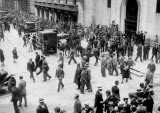
1929 Crash
•
lines outside the banks
•
the 1929 crash did not solely cause the Great Depression
•
economies were already weak in 1927 and 1928
•
Great Depression happens in two main stages: 1929 stock crash, 1931 European economic crisis (Creditanstalt in Vienna declares bankruptcy, Britain goes of gold standard)
•
1930 a delivering (liquidation) trend started, people clearing up their debts and "putting themselves back into cash"
•
so people were getting out of the stock market and stopped buying things, both public and private demand was going down
•
some save there should hve been a lot of public spending
•
banks were careful about printing paper money but that makes investors go to places which aren't printing more paper money
•
some argue that several countries working together could have increased their money supply
•
one problem was political, the inability to coorporate, the international politics regarding debt and trade
•
after 1929, Americans are lending less money to Western Europe, and Western Europe loans are holding up a lot Eastern European economy as well
•
in Vienna, Creditanstalt had to declare bankruptcy on May 11, 1931
•
1931, Britain announces suspension of gold standard, the country that was the anchor of the gold standard, "we're just going to print out our own money, guys, and we'll work out how to exchange it"
•
challenge to collective security
•
the early 1930s don't make sense unless you realize that the reactions to WWI are still reverberating
•
book: All Quiet on the Western Front (Im Westen Nichts Neues)
•
gripped a large world-wide audience
•
movie from 1930 very
•
book: Ernst Jünger "Storm of Steel", celebrates the wartime experience
•
Storm of Steel (In Stahlgewittern) has been criticized for glorifying war, especially when compared to Remarque's All Quiet on the Western Front. However Jünger was a combat soldier, who saw extensive front-line service. Remarque did not, and All Quiet on the Western Front is a work of fiction, not a memoir (Remarque was actually a sapper for only a few weeks near the front line).
•
imperial weariness of France and Britain
•
not expanding, trying to retreat from colonialism with dignity
•
1931: British had round table meetings with India to discuss Indian self government
•
ends in failure
•
Britain can't find a way to work themselves out of these burdens
•
1930s: the disarmament agenda is not being pursued
•
1932-1934: World Disarmament Conferences
•
Geneva
•
ends in failure
•
disagreements over what constituted "offensive" and "defensive" weapons
•
polarization of France and Germany
•
increasingly military-minded German governments could see no reason why their country could not enjoy the same level of armaments as other powers, especially France
•
British and US governments were unprepared to offer the additional security commitments that France requested
•
Hitler withdrew Germany from both the Conference and the League of Nations in October 1933
•
the 1930s had proved far too self-interested an international period to accommodate multilateral action in favor of pacifism